五度易链产业数字化管理平台
25年4QのDRAM市場、SamsungがSKから首位奪還

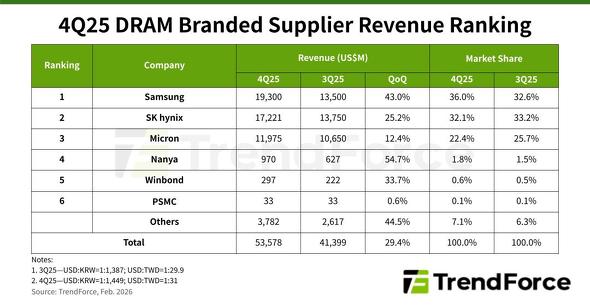
台湾の市場調査会社TrendForceは2026年2月26日(台湾時間)、2025年第4四半期(4Q:10〜12月)の世界DRAM売上高の最新調査結果を発表した。それによると同市場は前四半期比29.4%増の535億7800万米ドルになった。ベンダー別ランキングではSamsung Electronics(以下、Samsung)が同43.0%増の成長を見せ、SK hynixからトップの座を取り戻した。 2025年第4四半期のDRAM市場ランキング[クリックで拡大] 出所:TrendForce TrendForceによると、AIアプリケーションが大規模言語モデル(LLM)の学習から推論へと拡大していることを受け、CSP(クラウドサービスプロバイダー)はデータセンターの建設をAIサーバだけでなく、汎用サーバも含める形で拡大。この動きによって、メモリの調達対象は広帯域メモリ(HBM)のHBM3EやLPDDR5X、高容量RDIMMにとどまらず、さまざまな容量のRDIMMへと広がっているという。さらに積極的な追加発注によって従来型DRAMの契約価格が急上昇。その結果、2025年第4四半期のDRAM市場全体の売上高は前四半期比29.4%増の535億7800万米ドルに拡大した。 TrendForceは「各市場セグメントにおいて需要と供給の差が拡大する中で、買い手は十分な供給を確保するのに苦戦している」と指摘。これによってサプライヤー側の価格決定力が大きく強まり、従来型DRAMの契約価格が前四半期比で45〜50%上昇。従来型DRAMとHBMを合わせた平均契約価格は50〜55%上昇したという。 SK hynixは25.2%増と堅調も、王座奪われる 2025年第4四半期の企業別売上高ランキングを見ると、Samsungが前四半期比43.0%増の193億米ドルとなり、SK hynixから首位の座を奪還した。平均販売価格(ASP)は同約40%上昇していて、上位3社の中で最も高い伸びを見せたという。一方で、ビット出荷量は一桁台前半の伸びにとどまってはいるが、HBM事業の拡大がこれを支え、会社の見通しとも一致する結果での着地となっている。市場シェアも3.4ポイント上昇し36%になった。 SK hynixも前四半期比25.2%増の172億2100米ドルと堅調に拡大しているが、Samsungに抜かれ2位に転落。市場シェアは1.1ポイント低下して32.1%になった。ASPは同20%台半ばの上昇を見せた。これは、契約価格の変動が比較的小さいHBMの売り上げ比率が競合他社より高いためだという。ビット出荷量は一桁台前半の増加で、ガイダンス通りだった。 3位のMicron Technologyは前四半期比12.4%増の119億7500万米ドルに拡大したが、市場シェアは3.3ポイント低下し22.4%となった。ASPは同約17%の上昇を見せたが、上位3社の中では最も低い伸びとなった。また、ビット出荷量は同約4%減となった。これは韓国の競合企業よりも早い段階で契約価格を交渉していた結果、実現した価格水準が相対的に低くなったことが背景とみられるという。 このほか台湾DRAMメーカーも、2025年第2四半期から続く好調な勢いを維持。2025年第4四半期には多くの企業で前四半期比30%を超える売り上げ成長を記録したという。TrendForceは「これらの企業は主に成熟プロセス製品に注力していて、大手メーカーが先端プロセスへ生産を移行する中で生じた供給不足を補う役割を果たしている」とコメントしている。 26年第1四半期、従来型DRAMの価格90〜95%増に TrendForceは2026年第1四半期の市場について、消費者向け需要の季節的な弱さがビット出荷量の伸びを抑制し、サプライヤーの四半期成長が横ばいになる可能性があるとしている。ただし、CSPは供給確保を優先し、より高い調達価格も受け入れる姿勢を示しているため「他の用途分野の顧客も割り当てを維持するためには同様に価格上昇を受け入れる必要がある」とも言及。2026年第1四半期には契約価格の上昇がさらに加速し、従来型DRAMの価格は前四半期比で90〜95%上昇し、従来型DRAMとHBMを合わせた価格も80〜85%上昇すると見込んでいるという。 26年1QにDRAM価格は9割超上昇へ、ソニーらの決算にみる波及の形 関連記事 2026年のメモリ市場は「制御された供給不足」に 主役はHBM4 TechInsightsのアナリストによると、「メモリメーカーは過去の好況と不況のサイクルから学び、AI主導の需要に対応するための増産において、より規律ある姿勢を示している」という。HBM/DRAMの供給不足が予測されているが、これはサプライチェーンの混乱によるものではなく、予想を超えるようなかつてない規模で導入が進んでいることが原因だ。 26年メモリ市場は134%成長 ファウンドリー市場の2倍超に TrendForceによると、AIブームによる需要増および供給制約と価格上昇を背景に、2026年のメモリ市場の市場規模は前年比134%増の5516億米ドルに達し、ファウンドリー市場の2倍以上になる見込みだという。 26年1QにDRAM価格は9割超上昇へ、ソニーらの決算にみる波及の形 メモリ価格の上昇ペースが一段と加速。各社の決算会見では、その影響を示唆する発言が出始めています。 王者SK hynixは16層HBM4「初公開」でアピール、競争過熱のメモリ業界 競争が激化するHBM市場。今回のCESでは、同市場で現在『王者』の座にいるSK hynixが、開発中の16層HBM4の実物および主要スペックを初公開し、そのリードを印象づけました。 2026年のHBM市況、カギを握るのは最新世代「HBM4」 2025年8月に開催された「FMS(the Future of Memory and Storage)」の一般講演を紹介するシリーズ。今回はTrendForceのアナリストであるEllie Wang氏の講演を取り上げる。広帯域メモリ(HBM)の生産能力や容量、価格を予測する。 DRAM市場でSK hynixが首位独走、Samsung引き離す 25年Q2 台湾の市場調査会社TrendForceによると、2025年第2四半期(4〜6月)の世界DRAM売上高は前四半期比17.1%増の316億3000万米ドルになった。ランキングではSK hynixが前四半期に続き首位となり、2位のSamsung Electronics(以下、Samsung)との差を広げた。 関連リンク プレスリリース(英文) Copyright © ITmedia, Inc. All Rights Reserved.

来源:EETimes Japan发布时间:2026-03-05
Siemens Reveals Agentic Questa

Key takeaways ▼ There’s no denying that verification now leads the field in agentic AI announcements, accelerating the trend around this significant contribution to design automation. Siemens have just announced their Questa One Agentic Toolkit, their response to this trend, building on the core Questa One platform. Questa One provides integrated simulation, static verification, embedded AI driving common management around those tools, also VIP in support of these functions. The Agentic Toolkit adds further automated creation and orchestration of verification tasks to provide end-to-end solutions. Boasting endorsements from NVIDIA and MediaTek among others, this update is worth a look. Strategy and foundation Announcements in this space are inevitably similar, so what makes the Siemens approach different? They are leading with a foundation of openness and organic development. Start with openness. The Agentic Toolkit provides MCP interfaces to underlying Questa One functions with the ability to connect to any agentic frameworks. Their own agentic app, Fuse, naturally fully utilizes these interfaces and is the “preferred” option but does not limit other frameworks from connecting. Sidebar on this point: tool providers have a natural advantage in knowing how best to use their own tools. That expertise can be captured in vectorized knowledge embedded in agentic apps. But how well does this work in a mix-and-match flow? More should be debated here between design teams and verification technology providers. The organic differentiation is also interesting. Siemens have built their Fuse EDA AI system in-house. Supported workflows leverage the NVIDIA Llama-Nemotron reasoning framework and NVIDIA NIM inference microservices, enabling the platform to understand verification state in real time and maintain comprehensive awareness and contextual intelligence relationships between designs, testbenches, test plans and specifications. No doubt thanks to these foundation frameworks this system apparently also works with main-stream AI coding applications, including GitHub Copilot, Claude Code, Cursor, and Cline, and can be used in command-line mode (for scripting) or through IDEs such as VS-Code. All this works with a multi-model EDA data lake, capturing baseline manuals and user documentation. An LLM exploits this information in assistants, reasoners, etc., to direct run objectives and orchestration. They also add that building on the existing connected ecosystem between Questa One, Tessent™ software for DFT and the Veloce™ CS hardware-assisted verification and validation system, the Agentic Toolkit supports a broad range of design and verification objectives. This system ships today with several pre-built and tested agents for customers who need a quick start in pilot trials: an RTL code agent, a Lint agent, a CDC agent, a verification planning agent and a debug agent. Expanding a little on the values they describe, the Verification Agent organizes tasks, coverage goals, and requirements, offering AI-driven suggestions for efficient resource allocation, from which engineers gain clarity, adaptability, and accelerated closure, ensuring comprehensive verification and faster project success. The Debug Agent accelerates root-cause analysis by pinpointing issues in RTL and testbenches with AI-driven insights. It offers targeted suggestions, automates error tracing, and guides engineers to efficient resolution. With smart diagnostics, it reduces debug cycles and boosts productivity, helping teams deliver robust designs faster. What about guardrails and trust? This a question I am now asking all agentic verification solution providers. The upside of hands-free automation is huge; the downside of unsupervised AI could be even more dramatic. I asked Abhi Kolpekwar (Sr. VP and GM at Siemens Digital Industries) for his views on this challenging balance. Abhi agreed that while across all industries there is buzz around the potential of AI and agentic methods, there is equally buzz around hype outrunning reality and most pilot programs failing to translate to production. How do successful deployments navigate this challenge? Abhi had a two-part answer. First, while those surveys certainly highlight a problem, we shouldn’t underestimate the success AI/Agentic already enjoys in quietly successful embedded use-cases. Examples include cars (I have written recently about this), in our phones, and in factory automation. Another interesting example is a method to detect what you are saying by watching your facial muscles, even without needing to hear clear speech. Not available yet but presumably coming to a phone, car or other device near you in the not-too-distant future. Intriguing, but in SoC and system we are very sensitive to reliability and pinpoint accuracy. How can AI/Agentic align with these needs? In Abhi’s view, one way to secure that level of quality is through guardrails implemented using proven and non-AI core EDA technologies: formal methods, simulation, and so on. The second way is to implement processes which require human-in-the-loop judgement at checkpoints. There can still be a big win, even though the whole process isn’t pushbutton. With agentic support, DV engineers graduate from being tool operators, knowing all minutiae of how to run (and debug) scripts and tools, to instead becoming verification scientists, knowing how to judge outcomes at intermediate steps, and what high-level correction they might want to try to correct an outcome. I like it – what DV engineer wouldn’t want to upgrade their day-to-day workload to become a verification scientist? Nice positioning. Still, the proof will be in how DV engineers and product managers will react in practice. You can read more about the release HERE and get more insight on product details HERE. Share this post via:

来源:SemiWiki.com发布时间:2026-03-05
North America chart of the week: Greenland threat on hold for now

North America chart of the week: Greenland threat on hold for now Fri, 23rd Jan 2026 Article tags BusinessGeopoliticsSupply chainsTradeGlobalUnited StatesCountry Analysis Markets had a turbulent week following the surprise announcement on January 17th by the US president, Donald Trump, of his intention to levy 10% tariffs on Denmark and seven other European countries until they agreed to sell Greenland to the US. When markets reopened on Monday, equities sold off sharply, Treasury yields soared as investors fled US bonds and gold surged as a safe-haven bid. The US dollar, atypically, weakened rather than strengthened during the risk-off move. Relief came swiftly. By the evening of January 21st Mr Trump announced that he would drop the tariff threat after securing a NATO framework agreement on Arctic security, which appears to include some increased US control over at least portions of Greenland. The S&P 500 staged an immediate recovery, erasing most of the week’s losses, and Treasury yields retreated from their highs. The classic pattern of risk assets selling off on bad news and recovering on its resolution played out as expected, at least for domestic US markets. A potential near-term policy shock had been avoided with the climbdown and announcement of a framework to resolve Mr Trump’s ambitions with respect to Greenland. Gold and the US dollar, however, tell a different story. Gold kept rising—ending the week up almost 7%—whereas the US dollar stayed below the level it was before the tariff announcement. A useful way to read that divergence is that even though the near-term event risk faded, the medium- to longer-term policy uncertainty and regime risk did not. Equities and Treasuries can reprice quickly once an immediate tariff cliff is removed: the near-term hit to earnings and inflation expectations is pared back. Foreign exchange and gold are more sensitive to the risk premium investors demand to hold US dollar exposure in the first place. As the episode probably raised the perceived probability of further abrupt policy moves—even if this specific threat was withdrawn—foreign investors might seek to reduce unhedged US dollar exposure or increase hedging without selling the underlying US assets. That would keep the US dollar soft even as rates and equities recover. Gold prices then rise both mechanically from a weaker US dollar and from greater “insurance” demand against the increased policy uncertainty. Despite the tariff climbdown and the pledge not to use force to gain the territory, we still believe that the ultimate resolution of the Greenland dispute is highly uncertain. The “framework” floated after Mr Trump’s meeting with NATO secretary-general, Mark Rutte, is thin on detail, and any attempt to translate it into a durable arrangement will run into political and legal constraints, most obviously the need for buy-in from Greenland and Denmark, where domestic constituencies have been clear that sovereignty is a red line. More broadly, the episode is further evidence of Mr Trump’s increasingly assertive and erratic foreign policy. In our view, a tactical retreat does not undo the damage already done to transatlantic trust. Speeches at the World Economic Forum by leaders including Canadian prime minister, Mark Carney, German chancellor, Friedrich Merz and French president, Emmanuel Macron point to a more concrete European assessment that the US is becoming a less reliable actor, and that there has been an erosion of confidence that will not be reversed quickly by a single climbdown. The analysis and forecasts presented in this article are drawn from EIU’s Country Analysis service. This comprehensive solution offers essential insights into the political and economic outlook of nearly 200 countries, empowering businesses to manage risks and develop effective strategies. Fri, 23rd Jan 2026 Article tags BusinessGeopoliticsSupply chainsTradeGlobalUnited StatesCountry Analysis

来源:Global insights and market intelligence发布时间:2026-01-24
Auto chart of the week: Self-driving tech is advancing

Auto chart of the week: Self-driving tech is advancing Fri, 16th Jan 2026 Article tags AutomotiveTechnologyGlobalCountry AnalysisAutomotive In 2026 the race for robotaxi dominance is revving up across the world. In London two US-based ride-sharing companies, Uber and Lyft, will begin testing self-driving cars manufactured by Baidu, a Chinese technology company that owns the popular Apollo autonomous driving platform, in the course of this year. This follows a similar move by Waymo, a unit of US-based Alphabet, which also started testing its own robotaxis in London in October 2025. These developments would help to position the UK as a key European hub for robotaxi testing, amid direct competition between US and Chinese robotaxi companies. While EU regulations have lagged, the UK passed its Autonomous Vehicles Act (AVA) in 2024, creating a legal framework for self-driving cars – including new safety standards and defining the scope of liability in case of accidents. A number of EU countries have also set out legal frameworks for autonomous-driving testing, with harmonised EU rules expected by the end of 2026. Progress on robotaxis (and autonomous driving, on the whole) is not limited to Europe, however. In the US, meanwhile, companies have moved from testing to full commercial deployment. In mid-November 2025 Waymo expanded its autonomous-taxi service to include freeways across parts of California and Arizona in the US, making it the first to offer fully-autonomous freeway rides in the country. This marks an important milestone as self-driving on freeways requires high control over vehicle navigation, speed and manoeuvrability. In the same month Baidu’s Apollo Go robotaxi service, which already operates in dozens of Chinese cities, claimed that it had matched Waymo’s record of 250,000 passenger rides per week. This number is likely to soar further in EIU’s forecast period (2026-30) as the cost of mass production and the economies of scale become more favourable for autonomous vehicles, along with increasing safety and access. These trends pose a challenge for established carmakers, whose development of self-driving vehicles has partly relied on partnerships. For instance, Stellantis (Netherlands) and Volkswagen (Germany) have partnered with Nvidia, a US tech firm, and Mobileye, an Israeli autonomous tech company, respectively, to build and mass-produce Level 4-autonomous vehicles. Meanwhile, Japanese carmakers, Toyota and Nissan, have licensed self-driving technology from Waymo and Wayve, a UK artificial intelligence (AI) firm, for deployment in their vehicles. In future, however, mass deployment of self-driving tech will become a key differentiator for automakers, putting pressure on them to develop their own in-house tech. General Motors (US) has been doing just that with its Super Cruise advanced driver assistance system. A number of Chinese carmakers have also launched or outlined plans for such systems in the coming years. Fri, 16th Jan 2026 Article tags AutomotiveTechnologyGlobalCountry AnalysisAutomotive

来源:Global insights and market intelligence发布时间:2026-01-17
数据流通服务机构是什么?一文解码内涵与定位

近期,国家数据局等四部门发布了《关于培育数据流通服务机构 加快推进数据要素市场化价值化的意见》(以下简称《意见》),数据流通服务机构是什么?如何发挥作用?请看专家解读↓ 文 | 复旦大学管理学院教授 黄丽华 我国改革开放以来,各类流通服务机构作为生产要素市场的中介服务组织,在生产要素市场培育和发展中起到了不可替代的作用。虽然数据要素与传统生产要素存在着不同的特性,但是要素流通服务机构的作用是有共性的。数据流通通俗来讲是指数据产品和服务在不同的主体之间进行流动,以实现数据再开发再利用。 我国目前数据市场的发展仍处于起步形成阶段,加快培育数据流通服务机构是数据要素市场化价值化的“壹引其纲”,通过各类数据流通服务机构多元化专业化发展,带动数据市场相关市场主体、市场客体、市场流通基础设施以及流通规则等的“万目皆张”。 一、认识数据流通服务机构的概念内涵 正如《意见》中所说,数据流通服务机构是链接数据供需双方,促进数据流通交易,推进数据要素市场化价值化的重要主体。这个概念高度概括了数据流通服务机构在数据市场中扮演的功能角色和作用定位。 (一)数据流通服务机构的业务功能:链接数据供需双方 “链接数据供需双方”是指通过流通交易规则的制定、供需匹配或撮合、合约和交付、支付和清结算等一系列活动,实现数据供方的数据产品和服务与需方的数据应用需求间的精准匹配,并保障数据流通全流程合规高效安全的市场行为。“链接数据供需双方”是数据流通服务机构基础性的业务功能,具体来讲包括参与数据流通规则的制定,以有效降低流通交易成本;挖掘数据市场需求潜力,以实现供需交易匹配;提供数据产品与服务的交付技术及基础设施服务,以提高数据流通效率。 (二)数据流通服务机构的市场功能:促进数据流通交易 市场功能是指数据流通服务机构对整个数据市场所产生的积极作用,就是促进数据流通交易。目前我国数据供方和需方在资源、市场专业能力等方面亟待提升,“促进数据流通交易”这一市场功能具体来讲主要有三个方面,包括引领数据市场生态的发育与成长,开发或协助开发适销对路的数据产品和服务;承担市场评价与选择功能,促进市场主体、市场客体和市场载体(基础设施)的快速迭代,形成有序健康的数据流通市场;发挥市场信息汇聚与传导功能,汇聚来自多源的数据产品和服务供给、流通、使用反馈等市场信息,促进供需匹配效率的提升。 (三)数据流通服务机构的制度性功能(职责):成为推进数据要素市场化价值化的重要主体 制度性功能是指数据流通机构需要发挥协助政府弥补市场失灵所应起的作用,成为推进数据要素市场化价值化的重要主体。近年来的实践表明,数据流通是以企业点对点这种无形市场流通方式为主,而数据流通服务机构所承载的有组织市场流通场所(marketplace)的规模还比较小。数据流通服务机构在市场制度规则的指引下,针对数据流通标的物的特性和数据市场发育特性,通过一系列创新业务和活动来促进数据市场化价值化发展,并赋能实体经济。千行百业企业对数据要素的需求不同,市场特性不同,数据市场需要多元化的数据流通服务机构来提供专业化的服务。 二、充分发挥三类机构的作用 实践来看,三类机构形成了不同的发展路径和模式,在推进数据市场化价值化中发挥的功能作用各有侧重。

来源:数智浦东发布时间:2026-03-03
ESI Motion Showcases Control and Power Tech at Satellite 2026 and AUSA Global Force 2026

ESI Motion, a leader in high-performance control and power systems for space and defence applications, announced it will have company representatives attending Satellite 2026 in Washington, D.C., and AUSA Global Force 2026 in Huntsville, Alabama. With deep expertise in precision space-rated and ruggedised motion controllers, actuators, and next-generation space battery systems, ESI Motion continues to support critical missions across satellite communications, national security space, missile defence, and ground combat platforms.Also Read: What are the Different types of Batteries used in Space?At Satellite 2026, ESI Motion representatives will engage with commercial and government space leaders to discuss scalable solutions for:Satellite attitude and orbit control systemsDeployable solar array drive assemblies (SADAs) and solar array deployment mechanisms (SADEs)High-efficiency servo drive architecturesSpace-rated battery technologies optimised for LEO and beyondAt AUSA Global Force 2026, the team will connect with U.S. Army and defence stakeholders to highlight motion and power technologies designed for:Missile and launcher systemsAutonomous defence platformsRuggedised power management systemsHigh-reliability actuation control for mission-critical defence applicationsESI Motion is focused on delivering precision, durability, and performance where failure is not an option. These events provide an opportunity to collaborate directly with mission leaders shaping the future of space and defence operations. ESI Motion invites attendees of Satellite 2026 and AUSA Global Force 2026 to schedule a one-on-one meeting with company representatives to discuss program requirements, partnership opportunities, and custom engineering support.Click here to learn more about Satellite 2026 Publisher: SatNow https://www.satnow.com https://cdn.satnow.com/logo.png 236 48 Tags:- Satellite, LEO, Actuators, Ground, Power Systems

来源:SATNOW发布时间:2026-03-05
METI Hosts “Public-Private Dialogue towards Robust and Resilient Copper Supply Chains”

Japanese Print Home News Releases Back Issues March FY2026 METI Hosts “Public-Private Dialogue towards Robust and Resilient Copper Supply Chains” METI Hosts “Public-Private Dialogue towards Robust and Resilient Copper Supply Chains” Japanese March 4, 2026 Energy and Environment Policy METI hosts the Public-Private Dialogue towards Robust and Resilient Copper Supply Chains in Toronto, Canada, on Tuesday, March 3, and engaged in discussions with domestic and international copper industry stakeholders as well as government representatives. METI hosted the Public-Private Dialogue towards Robust and Resilient Copper Supply Chains on the occasion of the Prospectors & Developers Association of Canada Convention (PDAC), inviting smelting companies, mining companies, and relevant government agencies involved in the copper supply chain from a total of 14 countries and regions. From the Japanese side, METI, JOGMEC, and copper smelting companies participated in the dialogue. During the first half of the meeting, which consisted of panel discussions by an international organization, private-sector companies, and an industry consulting firm, panelists expressed concerns toward the over-capacity of new smelting companies in specific regions and the resulting imbalance of supply and demand in the copper concentrate market. They also emphasized that the sharp decline in treatment and refining charges (TC/RC), driven by these market distortions, has raised questions about the long-term economic sustainability of smelting companies. In the latter half of the meeting, during the public-private dialogue, participants exchanged views on the need to pursue sustainable TC/RC that reflect actual business situations—not merely relying on traditional benchmark-based approaches. Recognizing that global demand for copper is expected to rise further with the expansion of AI infrastructure, renewable energy, and other developments, METI and stakeholders affirmed that this dialogue serves as a starting point for continued public-private collaboration to build a resilient copper supply chain. The participants confirmed their commitments to addressing the challenges surrounding TC/RC and ensuring the long-term sustainability of the copper industry. Remarks by the chair Panel session Public-Private Roundtable Related Link The Ministry of Economy, Trade and Industry of Japan held a meeting with the Ministry of Industry and Tourism of the Kingdom of Spain, and with the Ministry of Trade, Industry and Resources of the Republic of Korea, to deliberate on the sustainable development of the copper smelting sector. Following these discussions, the three countries jointly compiled a statement entitled “Joint statement on unsustainable Treatment Charges and Refining Charges (TC/RC). Division in Charge Mineral Resources Division, Manufacturing Industries Bureau

来源:日本经济产业省发布时间:2026-03-04
U.S. Chemical Manufacturers Grew Despite Overall Manufacturing Decline

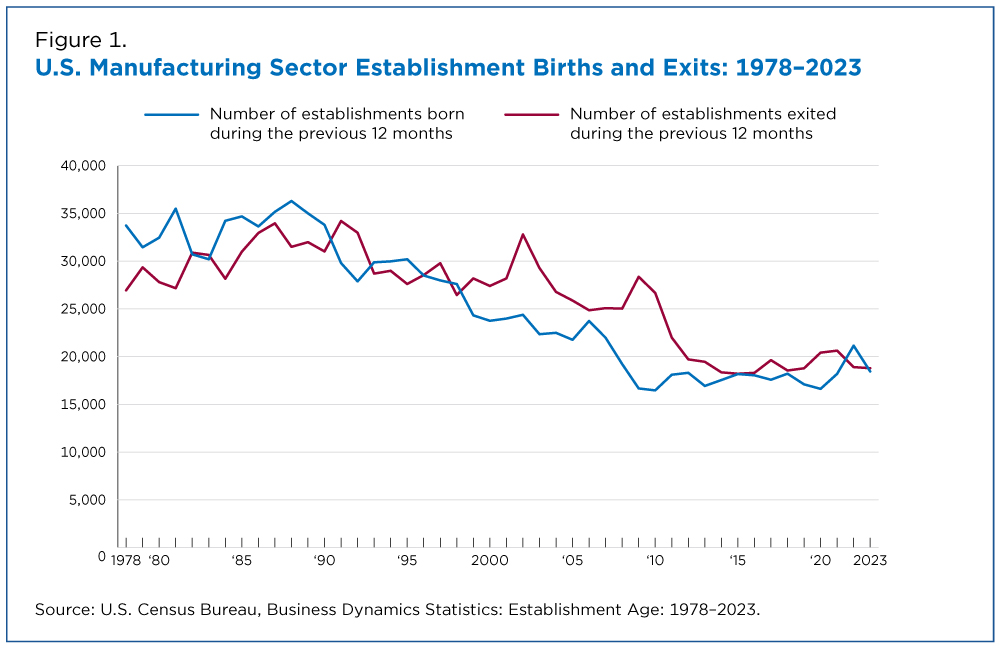
Most people may not realize the close connection they have with the Chemical Manufacturing industry, but it’s a subsector that helps create commonplace products we all use, from ink and soap to plastics and medicine. And it’s a portion of American manufacturing that has grown in recent years, running counter to the overall decline in manufacturing establishments and firms from 2017 to 2022, according to the most recent Economic Census. Expanded industrial production by pharmaceutical companies was a big contributor to the boost in Chemical Manufacturing. The North American Industry Classification System (NAICS) defines chemical manufacturing as the transformation of raw materials by a chemical process into everyday products. Businesses that manufacture chemicals run the gamut from refining oil into margarine to synthesizing willow bark into aspirin. The number of U.S. Chemical Manufacturing establishments (NAICS 325) increased 10.2% from 13,571 in 2017 to 14,961 in 2022 while the number of Manufacturing sector establishments as a whole decreased 1.7% during the same period, from 291,586 to 286,626, according to 2022 Economic Census data. Chemical Manufacturing value of shipments also increased by 22.4% during that period, rising from about $735.9 billion to $901.0 billion (the data are not adjusted for price changes). Industries with Chemistry What were the catalysts for growth? Expanded industrial production by pharmaceutical companies was a big contributor to the boost in Chemical Manufacturing. Production workers’ annual hours in the Pharmaceutical and Medicine Manufacturing industry (NAICS 32541), increased from 270.1 million to 341.6 million from 2017 to 2022, according to 2022 Economic Census data. Until recently, chemical manufacturer numbers loosely followed the trends in the broader Manufacturing sector. The 1978 to 2023 Business Dynamics Statistics (BDS) show that the manufacturing sector in general had a double-digit annual rate of new establishments until the early 1990s, when the number that shut down began to outstrip the newcomers (Figure 1). The highest-ever rate of Chemical Manufacturing establishment “births" — newly created establishments — occurred in 2022. “Exit” rates — the share of establishments that closed — peaked decades earlier and have been rising, with 2022 and 2023 marking the highest level in 20 years (Figure 2). Better Employment Through Chemistry? Despite growth in the Chemical Manufacturing industry, job numbers in industries downstream from these firms were in flux (Figure 3). Between 2017 and 2022, the number of pharmacists, chemical engineers, and chemists and material scientists increased about 28.1%, 54.5% and 24.8%, respectively. Chemical technicians, however, experienced a 2.2% decrease over the same period. The number of Pharmacies and Drug Stores establishments declined along with employment in the industry between 2017 and 2022. Overall, employment in Pharmacies and Drug Stores decreased by about 5.6%. Geographic Locations Chemical Manufacturing firms and revenues weren’t spread evenly across the nation. In 2023, a significant portion of the industry’s workforce was concentrated in the South and Midwest, with 334,398 and 242,706 employees, respectively, according to the 2023 Annual Integrated Economic Survey (Table 1). Chemical Competition How competitive was the Chemical Manufacturing subsector? A look at “concentration ratio,” or the market share held by an industry’s largest companies, can provide information about that industry’s competitiveness. A high concentration ratio indicates that the biggest companies own a large portion of a given industry, which can stifle competition, increase prices and hamper innovation. For example, the four largest firms in the Petrochemical Manufacturing industry (NAICS 325110) illustrate a much higher level of concentration, accounting for approximately 74.2% of the industry’s $77.6 billion in value of shipments for 2022. In contrast, an industry like Medicinal and Botanical Manufacturing (NAICS 325411) is relatively less concentrated. The top four firms accounted for about 24.7% of the industry’s $13.9 billion in value of shipments in 2022. Manufacturing Data Resources To learn more about Chemical Manufacturing workforce statistics, including earnings, hours and workplace trends, visit the Bureau of Labor Statistics “Industries at a Glance”. For additional resources to the latest manufacturing data, visit the Census Bureau’s Economic Briefing Room. Lynda Lee is a supervisory survey statistician at the Census Bureau. Travis Shoemaker is a writer/editor at the Census Bureau. This article was filed under: Business and Economy Employment Related Statistics Business and Economy The Census Bureau produces economic data from across the entire U.S. economy on a monthly, quarterly, yearly, and five-year basis. Manufacturing Week The U.S. Census Bureau joins the celebration by providing a week's worth of rich content, including statistics that inform businesses and policymakers. Subscribe Our email newsletter is sent out on the day we publish a story. Get an alert directly in your inbox to read, share and blog about our newest stories. Sign Up Today Contact our Public Information Office for media inquiries or interviews.

来源:United States Census Bureau发布时间:2026-03-05
加拿大发布国防工业战略,增材制造被列为关键赋能技术

本帖最后由 冰墩熊 于 2026-3-5 17:16 编辑 2026年3月5日,南极熊获悉,加拿大联邦政府推出了一项国防工业战略,旨在调整军事采购方向,转向国内生产、供应链安全和长期工业能力发展。这个战略与2025年预算案中宣布的818亿加元国防再投资计划同时发布,其中拨款66亿加元用于扩大工业能力,并减少对外国供应商在关键系统和材料方面的依赖。该战略指出,新冠疫情期间的供应中断以及俄罗斯入侵乌克兰暴露了全球国防供应链的脆弱性。 微信图片_2026-03-05_170552_962.jpg (74.43 KB, 下载次数: 0) 下载附件 保存到相册 5 小时前 上传 △加拿大国防工业战略到2035年的预计经济影响 采购将采用新的“建设-合作-购买”框架,优先考虑被定义为自主能力领域的国内制造。这些领域广泛覆盖了航空航天平台与航空电子、陆地车辆与海洋系统、弹药与复杂弹药、安全数字与通信系统、传感器、天基监视、训练与模拟环境,以及无人与自主平台。值得注意的是,上述领域中,增材制造技术因在设计灵活性、快速原型和分散式后勤方面的独特优势,已被明确视为关键的赋能工具。 微信图片_2026-03-05_170749_148.jpg (24.92 KB, 下载次数: 0) 下载附件 保存到相册 5 小时前 上传 增材制造在国防后勤与生产中的核心作用 战略文件特别强调了增材制造在多个关键领域的应用潜力: ●延寿与后勤保障: 对于拥有数十年服役周期的陆地车辆(如装甲车)和海军平台(如舰艇和破冰船),这些老旧或已停产零部件的供应一直是保障难题。增材制造技术能够按需生产备件和维修工具,有效延长装备寿命并显著减少供应链延误。这个战略对陆地系统和海洋平台国内制造能力的重视,为这一已在实际应用中证明价值的分布式生产模式提供了广阔前景。 ●自主系统与快速迭代: 在无人机、无人车及水面/水下无人平台等优先发展的自主能力领域,以及弹药生产方面,快速原型制造和设计迭代至关重要。增材制造技术能够实现轻量化结构、快速设计验证和复杂几何形状部件的制造,已在国防研发项目和早期平台开发中展现出缩短开发周期的巨大潜力。 ●航空航天与复杂系统: 在航空电子、传感器和天基监视等领域,增材制造已被广泛应用于生产轻量化组件、工装和替换零件,特别是针对那些需长期保持运行状态的系统。 微信图片_2026-03-05_170735_280.jpg (46.28 KB, 下载次数: 0) 下载附件 保存到相册 5 小时前 上传 △加拿大海军利用3D打印部件重塑维修供应链,延长潜艇服役寿命 新机构驱动战略实施与产业升级 为确保战略落地,加拿大政府已成立国防投资局(DIA),这一采购机构于2025年10月开始运行,旨在整合此前分散的采购职能,加速决策流程并向业界发出清晰的需求信号。政府计划于2026年通过立法,将DIA转型为独立实体,全面负责“建设-合作-购买”框架的实施,并强化产业参与要求。 研发是这项战略的另一重点。政府对国防相关研发的投入将增加85%,旨在加快从实验室研究到实际应用的转化。新成立的国防研究协调机构BOREALIS将支持人工智能、量子系统、网络安全、机器人和自主平台等领域的研究工作。军事靶场和作战环境也可能向国内企业开放,以支持测试和原型开发。 微信图片_2026-03-05_170940_559.jpg (154.78 KB, 下载次数: 0) 下载附件 保存到相册 5 小时前 上传 △加拿大航天局和AON3D,将3D打印部件发送到太空用于医学研究 经济目标与供应链韧性 目前,加拿大国内国防制造业拥有近600家企业,为国内生产总值贡献96亿美元,并提供了超过8.1万个就业岗位。未来十年的政策目标包括:将行业收入提高240%以上,将国防出口提高50%,并创造多达12.5万个新增就业岗位。中小企业约占该行业企业总数的92%,因此在扩大制造能力和将加拿大供应商融入盟国国防供应链方面发挥着核心作用。 供应链韧性是此次战略的另一支柱。加拿大国防工业韧性计划将扩大国防材料和零部件的国内生产能力,首先从弹药和炸药制造入手。这项计划包括到2029年建立国内硝化纤维素生产能力,并加强钢铁、铝和国防技术所需关键矿物的国家产能。加拿大目前生产北约12种国防关键原材料中的10种。 到2035年,与该战略相关的采购、基础设施投资及相关产业活动总额可能超过5000亿美元。政策文件将这项工作定位为一项将产业政策与国家安全联系起来的结构性转变。对于航空航天、国防系统、机器人和先进材料等领域的制造商而言,这项战略优先发展的行业正是增材制造技术应用于原型制作、维护和分布式生产的关键领域。

来源:南极熊3D打印发布时间:2026-03-05
颠覆航空通信!全球首条飞机与同步卫星激光链路打通:传输速率2.6Gbps

快科技3月5日消息,据媒体报道,欧洲空间局(ESA)、荷兰应用科学研究组织(TNO)与德国有效载荷制造商泰萨特(TESAT)近日达成一项里程碑式的突破——成功搭建全球首条飞机与地球同步卫星间的吉比特级激光通信链路。 据欧洲空间局官方透露,此次试验在法国尼姆开展,实现了持续数分钟的2.6 Gbps零误码传输,飞机终端与远在3.6万公里之外的阿尔法卫星(Alphasat)TDP-1载荷成功建立稳定连接。 在如此遥远的距离上,面对高速飞行的飞机、变幻莫测的云层遮挡以及复杂的大气环境,仍能实现精准通信,堪称一项巨大的技术挑战。此次突破不仅是欧洲空间局在激光通信领域的关键进展,更让这项技术向成为航空卫星通信主流方案迈出了实质性一步。 空中客车防务与航天公司互联智能部门负责人弗朗索瓦·隆巴尔评价称,这一里程碑将为未来数十年商用及军用激光卫星通信打开广阔空间。卫星与飞机间的激光通信一旦普及,将使飞机上的高速互联网接入成为可能,其网速可媲美地面光纤宽带,这是传统无线电卫星难以企及的能力。 激光传输不仅速度远超无线电波,其极窄的光束还能有效避开全球日益拥堵的无线电频段带来的速率限制,从而提供更稳定、高效的连接。 尽管激光通信卫星此前已有应用,但既未能在如此高的地球同步轨道上提供吉比特级带宽,也未能与飞机作为移动终端实现稳定对接。 此前美国“太字节红外传输”(TBIRD)卫星虽创下高达200 Gbps的传输纪录,但仅限于距离地表530公里的近地轨道。 此次欧洲空间局、TNO与TESAT联手实现的2.6 Gbps传输纪录,正值全球卫星发射日益密集、太空射频通信愈发拥挤的关键时期,其技术示范意义尤为突出,为未来航空通信与太空网络架构的演进提供了新的可能。 【本文结束】如需转载请务必注明出处:快科技 责任编辑:鹿角 文章内容举报

来源:鹿角 编辑发布时间:2026-03-05
奋羽电子推出3D砂型打印微波烘干设备系列,助力铸造数字化升级

本帖最后由 warrior熊 于 2026-3-5 22:19 编辑 导读:近年来,随着增材制造技术在铸造领域的快速落地,3D砂型打印正成为推动传统铸造产业升级的重要工具。从航空航天到汽车、能源装备,越来越多复杂结构铸件开始通过数字化铸造生产。相比传统木模或金属模具工艺,3D打印砂型可直接从三维模型生成型腔,大幅缩短开发周期,并降低复杂件制造成本。 然而,在实际生产流程中,一个看似不起眼但十分关键的环节——砂型烘干与固化,往往成为制约效率的瓶颈。南极熊获悉,针对这一行业痛点,国内装备企业成都奋羽电子科技有限公司(以下简称“奋羽电子“)推出了3D砂型打印微波烘干设备系列,通过微波加热技术提升砂型干燥效率,为砂型打印生产线提提供更稳定、更高效的后处理解决方案。 屏幕截图 2026-03-05 212036.jpg (45.17 KB, 下载次数: 0) 下载附件 保存到相册 半小时前 上传 深耕工业微波技术的创新企业 成都奋羽电子科技有限公司成立于2020年,位于成都高新区,是一家专注于工业微波能量应用技术研发与设备制造的高新技术企业。公司主要从事微波能量应用方案设计及设备开发,致力于将先进的微波技术应用于工业制造领域。 屏幕截图 2026-03-05 212926.jpg (55.1 KB, 下载次数: 0) 下载附件 保存到相册 半小时前 上传 奋羽电子是四川大学科技成果转化项目,依托高校科研资源开展技术创新,重点布局微波等离子体控制技术(MPCT)等核心技术方向。通过多年的研发积累,公司已经开发出多种工业微波设备及关键部件,在工业加热、材料处理和先进制造等领域形成了较为完善的技术体系。 系列化设备:面向不同规模3D打印铸造企业 根据铸造企业规模和砂型尺寸需求,奋羽电子开发了多规格微波烘干设备系列,包括:1000A、1800A、1800B及2600A型号,覆盖实验研发、小批量生产到规模化制造等多种场景。 图片1.jpg (409.45 KB, 下载次数: 0) 下载附件 保存到相册 半小时前 上传 3D砂型打印微波烘干设备系列 1000A型微波烘干设备主要面向中小尺寸砂型的烘干应用,设备结构紧凑,适用于实验室验证及小批量生产环境。这款入门级设备主要面向快速原型制作与小批量铸造后的后续干燥场景。其核心特色在于采用多源阵列系统,通过8个独立微波源(总功率12kW)交错分布,实现多角度能量覆盖。该设备利用2450MHz高频精准加热,能高效穿透砂型直接作用于水分子,实现由内而外的快速升温,处理满箱仅需3小时。其优势在于能显著提升复杂形状砂型的干燥均匀性,减少开裂风险,相比传统传导式加热具有更高的能效比与更低的能耗。 1.jpg (175.42 KB, 下载次数: 0) 下载附件 保存到相册 半小时前 上传 1800A型是一款追求高效能与大型化的工业级设备,适用于汽车发动机缸体等铸件的大批量生产。其最大的技术亮点是“双频协同”系统:通过2450MHz快速蒸发表面水分,配合915MHz长波穿透深部,有效解决了传统干燥中“外焦里湿”的难题。该设备总功率达56kW,干燥效率比传统方式提升60%-80%,合格率可从82%提升至98%。此外,它采用旋转天线设计消除驻波效应,确保大尺寸砂箱内部热点分布均匀,是高端陶瓷与铸造行业的理想选择。 2.jpg (206.71 KB, 下载次数: 0) 下载附件 保存到相册 半小时前 上传 1800B型专注于自动化造型产线的集成适配,其机身紧凑(长度仅需2米),可直接嵌入现有产线替代冗长的燃气烘干段。该型号同样采用双频段协同加热,通过12路2450MHz单元与1路30kW915MHz单元配合,将1.5米厚砂型的干燥时间压缩至1小时以内。设备具备毫米级控温能力,各区域温差可控制在3℃以内。对于年产10万吨的铸件规模,该方案可将年度能耗成本从天然气的180万大幅降至75万,兼顾了极高的经济效益与绿色制造要求。 3.jpg (215.04 KB, 下载次数: 0) 下载附件 保存到相册 半小时前 上传 3200型号是该系列中的“产能怪兽”,专为大批量中小型砂型的快速生产而设计。它采用了双烘房并联设计,支持独立控制与交替作业,使整体产能提升100%。核心动力源自5路25kW的915MHz大功率微波系统,配合升降式双层辊道与自动托盘回收系统,最大程度压缩了周转时间。其微波能量利用率高达70%以上,干燥速度是传统天然气设备的3至5倍。该设备还配备了先进的屏蔽安全层,通过分区功率调控,确保在工业化高强度作业下依然保持卓越的加热一致性。 4.jpg (201.58 KB, 下载次数: 0) 下载附件 保存到相册 半小时前 上传 整体来看,上述几款设备通过不同规格和功率配置的组合,形成了较为完善的3D打印砂型微波烘干设备体系,为铸造企业在不同生产规模和应用场景下提供了灵活的设备选择。 微波加热:从“表面加热”到“体积加热” 奋羽电子所推出的3D砂型打印微波烘干设备通过多项创新设计,使微波能量能够更加均匀地作用于砂型结构,从而实现高效率的干燥处理。在砂型打印领域,这种技术特别适用于树脂结合砂或粘结剂喷射砂型的快速干燥,可显著提升生产节拍。 在设备结构设计方面,奋羽电子的微波烘干设备采用了多频率微波能量输入方案,并通过多路微波馈入腔体结构,使微波能量能够在设备内部形成更加均匀的电磁场分布。同时,设备还结合旋转天线结构与专用微波辐射器设计,使辐射出的微波能量能够更充分地作用于砂型材料内部。通过这种设计方式,设备能够有效解决传统烘干方式中“表面过热而内部未干”的问题,使砂型内部水分能够迅速蒸发,从而显著缩短干燥时间。根据企业介绍,该设备可大幅提升砂型打印后的干燥效率,并能够适应不同材料体系和不同尺寸砂型的烘干需求。 此外,奋羽电子在设备研发过程中还针对不同应用场景开展了大量工艺研究,通过分析微波能量与不同材料之间的相互作用机理,对设备参数和能量分布进行了持续优化,使设备能够在保证烘干效率的同时保持稳定可靠的运行。 屏幕截图 2026-03-05 213411.jpg (89.38 KB, 下载次数: 0) 下载附件 保存到相册 半小时前 上传 在3D打印铸造生产线中,后处理环节往往直接影响整体生产节拍。如果烘干周期过长,将成为制约生产效率的重要因素。奋羽电子推出的微波烘干设备,核心思路是将传统热风干燥升级为微波体积加热技术。 与传统加热方式不同,微波能够直接作用于材料内部的极性分子,使其产生高速振动并释放热量,从而实现由内到外的整体加热。这种方式具有几个明显优势:加热速度更快:内部直接升温,大幅缩短烘干时间;加热更加均匀:减少表面过热、内部未干的情况;能耗更低:减少无效热量损失;设备自动化程度高:可与3D打印生产线联动。 在实际生产中,这些优势能够显著缩短砂型干燥周期,从而提高3D打印铸造生产线的整体效率。对于需要批量生产复杂铸件的企业而言,高效率的后处理设备将成为提升产能的重要支撑。 屏幕截图 2026-03-05 213426.jpg (80.34 KB, 下载次数: 0) 下载附件 保存到相册 半小时前 上传 南极熊观察:3D打印铸造行业的产业升级 当前,中国正在形成完整的增材制造产业生态,从打印设备、材料到应用场景不断拓展。而在工业应用层面,铸造3D打印无疑是最具规模潜力的领域之一。 随着设备效率不断提升,以及数字化铸造工厂的建设,未来几年,3D打印砂型在汽车、工程机械、能源装备等行业的应用仍将快速增长。在这一进程中,像奋羽电子这样的装备企业,通过持续创新补齐关键工艺环节,也将成为推动产业升级的重要力量。 可以预见,随着打印效率、材料性能以及后处理技术的进一步突破,3D打印铸造正在从“新技术”逐渐走向“新生产方式”。而微波烘干这样的细分装备,或许正是让铸造增材真正迈向规模化制造的关键拼图之一。

来源:南极熊3D打印发布时间:2026-03-05
3D打印农场“春耕”忙

位于深圳市光明区的华速科技有限公司生产车间内,5000台不同系列的拓竹3D打印机正在有序运转,一批批新奇的3D打印玩具不断下线。按照业内习惯,工作人员称车间为"农场","华速3D打印农场"由此而来。 "目前,农场正在紧锣密鼓部署新产能,将有5000台拓竹3D打印机新增上线,再加上在江西萍乡布局的5000台3D打印机,2026年第一季度,我们的总数有望达到15000台,成为全球规模最大的3D打印农场。"华速3D打印农场创始人兼CEO李建向上海证券时报记者介绍。 D24845794010079018650_w1080h810.jpg (139.85 KB, 下载次数: 0) 下载附件 保存到相册 7 分钟前 上传 AI赋能3D打印 "我们农场的跨境电商订单量占比接近50%,主要销往北美、欧洲,海外消费者对3D打印玩具很感兴趣。"李建表示。 3D打印玩具何以走红?李建说:"在没有3D打印农场之前,3D打印玩具其实很少见,这相当于玩具的一种新生态。正是因为3D打印技术快速发展,包括打印精度提高、速度提升,逐渐解决了传统玩具制造的三大痛点,3D打印玩具才得以流行。" 具体而言,3D打印技术能让玩具在铰链结构等复杂结构方面实现一体成型,支持玩具颜色多样化,并且对爆款玩具产品响应速度更快。 "我们农场的FDM(熔融沉积成型)技术在国内处于领先水平,并且设备规模优势明显,能在短时间内进行大批量生产,构筑了产能壁垒。"李建表示,除具备可观的设备规模之外,AI生成与设计工具也为华速3D打印农场赋能,助推公司从代工逐步转向原创的模式转变。 走进华速3D打印农场设计部门,鱼化龙、恐龙、解压小鸡等造型各异的3D打印玩具琳琅满目,产品设计师们正对着电脑屏幕构思制图、酝酿新产品。据介绍,华速3D打印农场目前主要生产原创玩具产品,占农场总产品比例超过60%。 李建以农场原创的新年"福马"挂饰为例解释道:"今年是马年,这个挂饰的'福'字底下有一匹马的图案,寓意着马上有福。设计师只需提供图案,即可运用AI工具生成3D数据模型。如果有需要修改之处,也可以及时进行调整。更重要的是,设计师无需精通专业的3D软件,只要借助AI工具就能获得各种各样有趣的模型,大幅提高了产品设计效率。" 从"拼产能"到"拼创意" 面对业内爆款产品生命周期短、同质化竞争激烈的问题,华速3D打印农场采取了两大策略。李建表示:"一方面,公司总部今年组建了设计师团队,将自主开发更多有趣的3D打印玩具模型,并通过短视频等方式进行传播推广。另一方面,我们也会物色更多外部的优秀设计师,争取与其进行合作,获得IP授权制作玩具产品。" 汇纳科技潮玩产品负责人陈剑表示:"我们在设计过程中考虑到同质化竞争较多的问题,所以在部分玩具产品的造型中特意增加了国风元素。另外,通过不同的玩法增加趣味性、延长产品寿命,例如,3D打印玩具可换表情、可换配件、可换装,推出零件盲盒,让多个产品之间可进行合体,支持对玩具进行二次创作、涂色、改造等。" 展望2026年全年,李建认为行业将出现三类趋势:"一是3D打印玩具的细分品类进一步增多;二是3D打印技术在工业领域的应用面会越来越广;三是在FDM技术适用的细分领域,例如3D打印鞋子、灯饰、球类体育用品等,相关应用将不断增多。"2026年,华速3D打印农场还计划生产适用于无人机、机器人等领域的工业零件产品。 放眼华速3D打印农场所在的深圳市,以创想三维、拓竹科技、纵维立方、智能派等为代表的3D"深圳军团",目前已经拿下了全球入门级3D打印机市场的九成以上份额。 (来源:上海证券报)

来源:南极熊3D打印发布时间:2026-03-05
共73069条记录
  • 1
  • 2
  • 3
  • 4
  • 6090

产业专题

产业大脑平台

产业经济-监测、分析、

研判、预警

数智招商平台

找方向、找目标、管过程

产业数据库

产业链 200+

产业环节 10000+

产业数据 100亿+

企业数据库

工商 司法 专利

信用 风险 产品

招投标 投融资

报告撰写AI智能体

分钟级生成各类型报告