
Auto chart of the week: Self-driving tech is advancing
来源:Global insights and market intelligence原文链接

专属客服号

微信订阅号
大数据治理
全面提升数据价值
赋能业务提质增效
In 2026 the race for robotaxi dominance is revving up across…
Auto chart of the week: Self-driving tech is advancing
Article tags
Automotive
Technology
Global
Country Analysis
Automotive


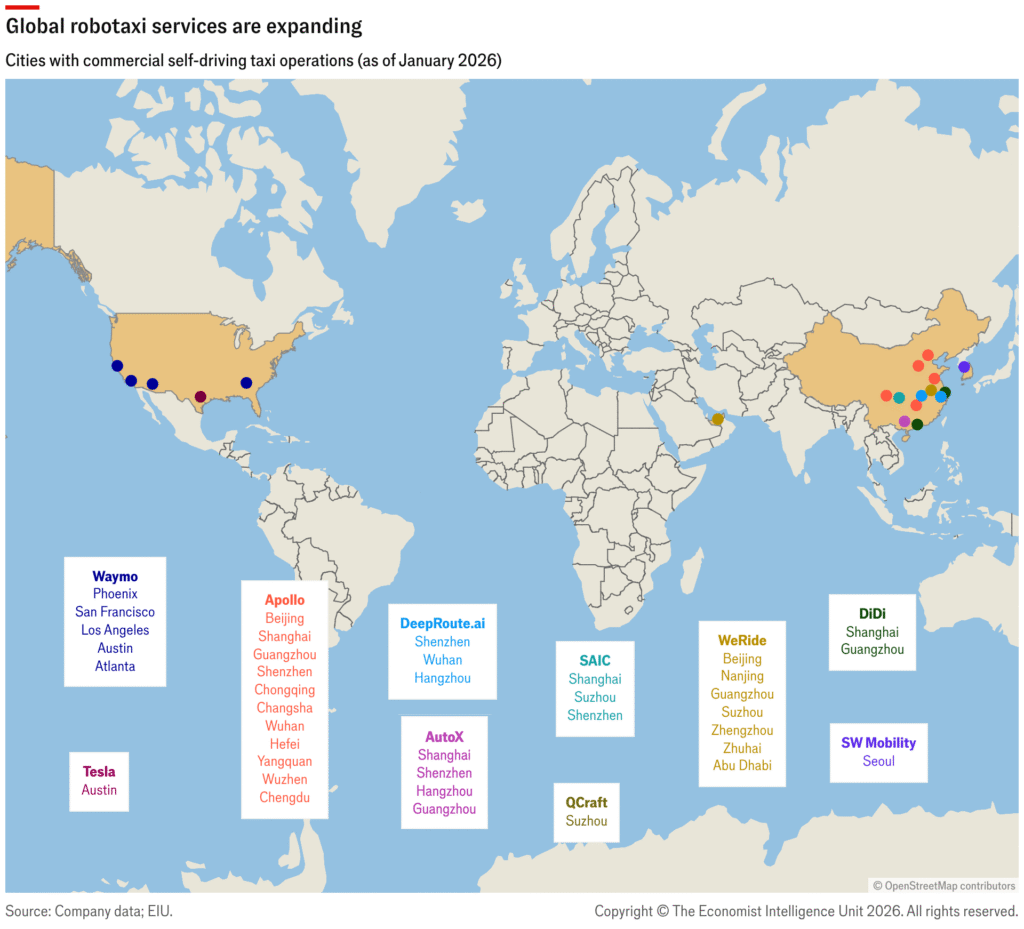
In 2026 the race for robotaxi dominance is revving up across the world. In London two US-based ride-sharing companies, Uber and Lyft, will begin testing self-driving cars manufactured by Baidu, a Chinese technology company that owns the popular Apollo autonomous driving platform, in the course of this year. This follows a similar move by Waymo, a unit of US-based Alphabet, which also started testing its own robotaxis in London in October 2025.
These developments would help to position the UK as a key European hub for robotaxi testing, amid direct competition between US and Chinese robotaxi companies. While EU regulations have lagged, the UK passed its Autonomous Vehicles Act (AVA) in 2024, creating a legal framework for self-driving cars – including new safety standards and defining the scope of liability in case of accidents. A number of EU countries have also set out legal frameworks for autonomous-driving testing, with harmonised EU rules expected by the end of 2026.
Progress on robotaxis (and autonomous driving, on the whole) is not limited to Europe, however. In the US, meanwhile, companies have moved from testing to full commercial deployment. In mid-November 2025 Waymo expanded its autonomous-taxi service to include freeways across parts of California and Arizona in the US, making it the first to offer fully-autonomous freeway rides in the country. This marks an important milestone as self-driving on freeways requires high control over vehicle navigation, speed and manoeuvrability.
In the same month Baidu’s Apollo Go robotaxi service, which already operates in dozens of Chinese cities, claimed that it had matched Waymo’s record of 250,000 passenger rides per week. This number is likely to soar further in EIU’s forecast period (2026-30) as the cost of mass production and the economies of scale become more favourable for autonomous vehicles, along with increasing safety and access.
These trends pose a challenge for established carmakers, whose development of self-driving vehicles has partly relied on partnerships. For instance, Stellantis (Netherlands) and Volkswagen (Germany) have partnered with Nvidia, a US tech firm, and Mobileye, an Israeli autonomous tech company, respectively, to build and mass-produce Level 4-autonomous vehicles. Meanwhile, Japanese carmakers, Toyota and Nissan, have licensed self-driving technology from Waymo and Wayve, a UK artificial intelligence (AI) firm, for deployment in their vehicles.
In future, however, mass deployment of self-driving tech will become a key differentiator for automakers, putting pressure on them to develop their own in-house tech. General Motors (US) has been doing just that with its Super Cruise advanced driver assistance system. A number of Chinese carmakers have also launched or outlined plans for such systems in the coming years.
Article tags
Automotive
Technology
Global
Country Analysis
Automotive
转载说明:本文系转载内容,版权归原作者及原出处所有。转载目的在于传递更多行业信息,文章观点仅代表原作者本人,与本平台立场无关。若涉及作品版权问题,请原作者或相关权利人及时与本平台联系,我们将在第一时间核实后移除相关内容。