五度易链产业数字化管理平台
Is AEQUITA placing a risky bet on a European chemicals renaissance?

Hot on the heels of its major purchase of European chemical production capacity from LyondellBasell, private equity firm AEQUITA has agreed to buy SABIC’s European Petrochemicals business. On the face of it, AEQUITA’s acquisitions are a vote of confidence in the future of Europe’s struggling petrochemical sector, but do they make sound financial sense? Our expert EMEA chemicals analysts have created an in-depth insight into the implications of the deal and the outlook for the sector in Europe. Complete the form at the top of the page to download a redacted version of the full report available to our Oils & Chemicals subscribers, or read on for a brief overview. What is AEQUITA acquiring? AEQUITA, a Munich-based private equity firm specialising in group carveouts and company succession, has agreed to acquire over 6 million tonnes of European olefins and polyolefins capacity across two deals. The company entered exclusive discussions with LyondellBasell in June 2025 as a potential newcomer to the chemicals sector. It confirmed the signing of a sales and purchase agreement for 2.9 million tonnes of the American multinational’s European chemical capacity in its Q3 2025 earnings call, with the deal expected to conclude in H1 2026. Then, in January AEQUITA announced a further deal to purchase the European Petrochemicals arm of SABIC, a chemical manufacturer majority owned by Saudi Aramco. The acquisition puts an enterprise value of US$500 million on the business, which includes 2.3 million tonnes of polyolefins capacity along with 1.1 million tonnes of olefins capacity. That deal is due to close in Q4 2026. Why the second European chemicals acquisition? According to AEQUITA, the SABIC transaction is a strategic move, adding complementary capacity to build what it calls “a scaled, competitive platform positioned for long-term, sustainable value creation”. The company now emerges as a significant market player, with seven large, strategic sites spread across the UK, Germany, France, Spain and the Netherlands. Announcing the deal, Managing Partner and Chairman Dr Axel Geuer said: “The assets are highly synergistic with the olefins and polyolefins business we recently acquired from LYB; with complementary markets, infrastructure and operational capabilities, we see potential to realise synergies and drive operational improvements across both businesses.” How will these deals impact European chemicals markets? Together, the two acquisitions will make AEQUITA Europe’s largest polyolefins producer, boasting 4.6 million tonnes of capacity, as well as its fourth largest ethylene producer, with 1.6 million tonnes of capacity. Prior to these deals, we forecasted that 15% of European polyolefins capacity would shut between 2025 and 2030. We predict that the perception of an improved environment for asset sales and the hope of legislative support to improve market conditions will encourage producers to ‘hang on’ longer. As a result, operating rates will suffer further. Do these deals make sense? On the face of it, a second major European deal in the space of twelve months for a new entrant to the petrochemicals sector may seem like a risky move. Subdued demand, volatile energy markets and aggressive Chinese buildout of chemicals capacity has left the global chemicals market in a precarious state. European petrochemicals production is additionally challenged by higher energy costs and cheap imports into the region — and our Asset Benchmarking Tools pinpoint the lack of competitiveness of many of the plants in the two deals. Thanks to an unusual deal structure, however, AEQUITA faces virtually no financial risk from the SABIC transaction. The seller is financing the purchase through vendor notes, which only require repayment if the business achieves strong performance or is successfully resold — thereby transferring acquisition risks from buyer to seller. Don’t forget to fill out the form at the top of the page to access the report extract, which explores this topic in much greater detail and includes a range of charts and data.

来源:Wood Mackenzie发布时间:2026-03-02
Smartphone shipments to fall 7% in 2026 amid memory constraints and geopolitical pressures

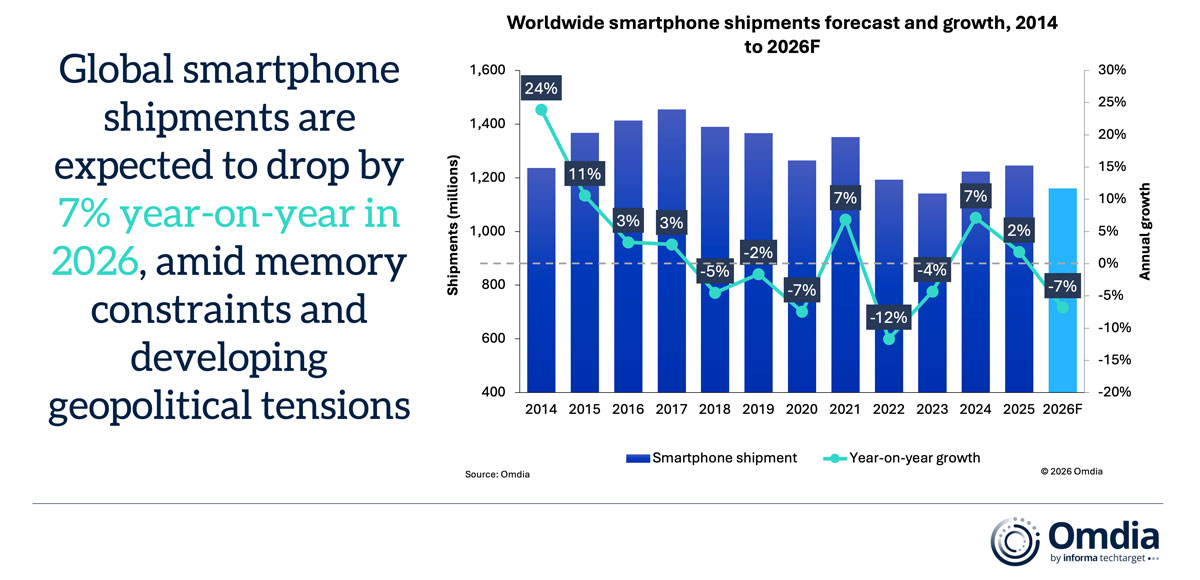
News: Markets 5 March 2026 Smartphone shipments to fall 7% in 2026 amid memory constraints and geopolitical pressures Based on assumptions on first-quarter memory prices (which indicate that pricing pressure and constrained supply will begin to ease in second-half 2026), Omdia’s latest outlook forecasts that global smartphone shipments will fall by about 7% year-on-year in 2026. Graphic: Worldwide smartphone shipments forecast and growth, 2014 to 2026F. The smartphone market will face significant challenges in 2026 as tightening memory supply and elevated pricing place increasing cost pressures on vendors. Memory now accounts for a significantly larger share of the smartphone bill of materials (BOM), eroding vendor profitability, particularly in entry-level devices. Since Q4/2025, smartphone makers have already begun raising retail prices in order to maintain profit margins. However, sustained price increases are likely to weaken demand, particularly in price-sensitive emerging markets. Further memory pressure and geopolitical volatility raise risk of over 15% smartphone shipment decline in 2026 Downside risks to the forecast remain significant. If memory prices continue rising into second-half 2026 due to tight supply and increasing AI server demand locking in production capacity, smartphone vendors will face further cost escalation across both entry-level and premium devices. At the same time, escalating geopolitical tensions in the Middle East could amplify macroeconomic volatility including higher energy prices, freight costs, and foreign-exchange instability, further weakening consumer upgrades in price-sensitive markets. Under this downside scenario, global smartphone shipments are expected to decline by more than 15% in 2026, potentially exceeding the 12% contraction recorded in 2022. “Rising memory costs and macro headwinds are expected to impact smartphone demand unevenly across price segments,” says principal analyst Zaker Li. “Devices priced below $100 are forecast to decline by nearly 31% year-on-year in 2026, reflecting the severe margin pressure vendors face in ultra-low-cost segments, which are highly sensitive to even modest shifts in the macroeconomic environment. Smartphones in the $100–399 range, which represent the core volume bands of the global market, are also expected to contract as rising memory prices push retail prices upward in price-sensitive markets. These segments are largely served by entry-focused vendors that rely heavily on LPDDR4X memory, operate with thin margins, and often have lower priority in the memory supply chain, leaving them more exposed to cost inflation and potential supply shortages. As a result, vendors concentrated in these price tiers are expected to face production constraints and shipment reductions, with many projected to experience double-digit declines in 2026,” he adds. Graphic: Smartphone shipment forecast by price band and annual growth, 2025 vs 2026F. “In contrast, the premium segment is expected to remain relatively resilient despite rising component costs. Devices priced above $800 are forecast to grow by around 4% in 2026, supported by stronger brand positioning and greater pricing flexibility. Apple maintains a dominant presence in the high-end market and benefits from strong supply chain relationships and higher margins that help absorb component cost inflation. Samsung also benefits from vertical integration and internal semiconductor capabilities, which provide greater security of supply and priority access to key components. While Samsung still utilizes LPDDR4X in some models and faces similar cost pressures, its supply chain advantages reduce the risk of significant shortages,” Li continues. “The evolving cost environment is reshaping dynamics across the global smartphone supply chain. As entry-level smartphone demand weakens, suppliers of mid- and low-end components – including chipsets, camera modules, and other key parts – are likely to face declining orders and intensified pricing pressure. Vendors are already responding by simplifying product configurations and tightening BOM costs. At the same time, volatility in memory pricing is pushing brands toward shorter-term production planning and smaller order volumes, increasing operational pressure across the supply chain. Smaller ODMs and specialized component suppliers will also face growing consolidation risks as margins compress and demand becomes more concentrated among leading brands. In this environment, vendors will need to prioritize higher-value product innovation and disciplined production planning, while channel partners strengthen inventory management and demand forecasting to navigate slower replacement cycles and shifting consumer demand.” Tags: Smartphone shipments Visit: technology.informa.com

来源:Semiconductor Today News发布时间:2026-03-05
Circuits Integrated Hellas and Reach Power sign multi-year strategic MOU

News: Microelectronics 5 March 2026 Circuits Integrated Hellas and Reach Power sign multi-year strategic MOU Satellite communication (Satcom) technology provider Circuits Integrated Hellas (CIH) of Athens, Greece and wireless power-at-a-distance technologies provider Reach Power of Redwood City, CA, USA, have announced a memorandum of understanding (MOU) establishing a multi-year strategic alliance. Focused on joint development of integrated radio frequency (RF)/millimeter-wave (mmWave) and wireless power and data transfer (WPDT) solutions, the alliance will target Satcom, defense, energy transfer, and other phased-array applications. CIH will serve as a specialized semiconductor design partner and chip supplier, including RF/mmWave ICs, system-level beamforming architectures, and heterogeneous integration approaches tailored for high-performance satellite and networked power systems. Reach Power will contribute its proven wireless power-at-a-distance technology, AI-optimized power-beaming control algorithms, and system integration expertise across platforms that demand simultaneous power and data delivery. Together, the companies plan to explore joint prototypes, reference architectures, and commercialization pathways that leverage complementary capabilities in silicon-level design and system-level power delivery. “CIH’s deep expertise in mmWave semiconductor design is a powerful complement to Reach’s wireless power-beaming platform,” says Reach Power’s founder & CEO Chris Davlantes. “Together, we’re focused on enabling tightly integrated power and data architectures that reduce system complexity and unlock new capabilities for defense, satellite, and networked energy applications,” he adds. “This agreement with wireless industry leader Reach lends further validation to CIH’s innovative approach and design services expertise,” says CIH’s CEO Paolo Fioravanti. “Moreover, it opens new opportunities for our award-winning Kythrion modules, intersecting perfectly for WPDT markets. This MOU enables joint development and early-adoption programs leveraging Reach’s extensive partner ecosystem — including NASA, defense integrators, and space, energy and wireless industry consortia.” Market opportunity The collaboration is reckoned to position both companies to capitalize on predicted strong growth in satellite communications and wireless power transmission. Multiple independent analysts are forecasting strong, sustained growth in advanced power and connectivity technologies through the 2030s. Satellite communications alone are expected to exceed US$200bn as demand rises for broadband connectivity, IoT services and low Earth-orbit (LEO) constellations, while wireless power transmission is projected to reach the large multi-billion-dollar scale as adoption broadens across sectors beyond consumer electronics. Against this backdrop, the Reach–CIH MOU targets this broader opportunity set by pairing CIH’s custom IC and RF expertise with Reach’s power-at-a-distance platform to unlock new system-level capabilities for government and commercial customers. Circuits Integrated Hellas is present in booth H30 at Space-Comm Expo Europe in London, UK, together with Space South Central (which CIH joined in November 2025). See related items: Circuits Integrated launches Ka-band integrated switch power amplifiers Tags: GaAs pHEMT Visit: www.reachpower.com Visit: www.circuitsintegrated.com

来源:Semiconductor Today News发布时间:2026-03-05
Semtech expands data-center portfolio by acquiring HieFo for $34m

News: Optoelectronics 5 March 2026 Semtech expands data-center portfolio by acquiring HieFo for $34m High-performance semiconductor, Internet of Things (IoT) systems and cloud connectivity service provider Semtech Corp of Camarillo, CA, USA has acquired HieFo Corp of Alhambra, CA –which manufactures indium phosphide (InP) optoelectronic devices for optical transceivers used across data-center interconnects (DCI) and intra-data-center interconnects – for about $34m in cash. The transaction has been reviewed by and received the non-objection of the Committee on Foreign Investment in the United States, in compliance with the Presidential order of 2 January demanding that HieFo divest the assets it acquired when it was formed on 30 April 2024 through a management buy-out of the digital chips business line and InP wafer fabrication operations of New Jersey-based Emcore Corp. “There is credible evidence that leads me to believe that HieFo… controlled by a citizen of the People’s Republic of China… might take action that threaten to impair the national security of the USA,” the order stated in January. Semtech says that adding HieFo to its portfolio of semiconductor solutions bolsters US technology supply chains, adding new capacity and resiliency at a key inflection point in the AI infrastructure buildout. It is also an opportunity to infuse critical upstream components for the optical module supply chain directly into Semtech’s growing data-center platform, adding another vital element to its chipset portfolio for data-center networking connectivity. “The evolution to 1.6T and 3.2T data-center architectures represents a fundamental shift in optical interconnect complexity,” says Semtech’s president & CEO Hong Hou. “By combining HieFo’s proven InP technology, including lasers and gain chips, with Semtech’s industry-leading TIAs [transimpedance amplifiers] and laser drivers, we can offer customers a comprehensive solution for next-generation optical platforms, including co-packaged optics (CPO) or near-packaged optics (NPO), strengthening Semtech’s position as a leader in high-bandwidth, low-power and low-latency networking solutions,” he adds. “Equally important, we believe strongly in the people and domestic capabilities we are bringing into Semtech through this acquisition, and we are committed to investing in their growth and success.” HieFo solutions HieFo continues to develop power-efficient optoelectronic component solutions to serve AI connectivity markets, leveraging more than four decades of innovation in optoelectronic devices. HieFo’s core technology centers on InP-based gain chips and distributed feedback (DFB) laser chips. Gain chips are the light-emitting building blocks embedded within tunable lasers that power coherent optical transceivers used across data-center applications. In addition, HieFo’s DFB laser platform offers best-in-class power and wall-plug efficiency over temperature for intensity-modulation direct-detection (IMDD) links used in optical transceiver modules. By acquiring HieFo, Semtech gains the ability to co-develop and co-optimize InP optoelectronic chip performance alongside its TIAs and laser/modulator drivers, creating an optimized electronic-optoelectronic-photonic chipset for high-bandwidth transceivers. Semtech says that this level of integration enables tighter performance optimization across the laser-modulator-driver interface, reduces system power consumption, and offers differentiated products for hyperscalers, navigating the demanding requirements of 1.6T and next-generation 3.2T optical modules. Investment and hiring plan To meet significantly growing demand from hyperscalers and other customers across the AI ecosystem, Semtech has initiated an investment and hiring plan at HieFo’s site in Alhambra to expand domestic manufacturing capacity and accelerate product development. Integration of HieFo into Semtech’s operations is underway, with the transaction expected to be accretive to non-GAAP diluted earnings per share within the first year. Semtech at OFC 2026 Semtech is exhibiting in booth #1812 at the Optical Fiber Communication Conference & Exposition (OFC 2026) in Los Angeles, CA, USA (17–19 March). See related items: US orders HieFo to divest Emcore indium phosphide assets POET and Semtech launch 1.6T optical receivers for AI networks Tags: Optical communications Visit: www.ofcconference.org Visit: www.hiefo.com Visit: www.semtech.com

来源:Semiconductor Today News发布时间:2026-03-05
Navitas and EPFL demo 250kW solid-state transformer

News: Microelectronics 5 March 2026 Navitas and EPFL demo 250kW solid-state transformer In booth #2027 at the IEEE Applied Power Electronics Conference (APEC 2026) in San Antonio, Texas (22–26 March), Navitas Semiconductor Corp of Torrance, CA, USA is exhibiting a 250kW solid-state transformer (SST) platform developed by the Power Electronics Laboratory of Switzerland’s École Polytechnique Fédérale de Lausanne (EPFL) that enables the grid architecture required by next-generation data centers, eliminating bulky low-frequency transformers while improving end-to-end efficiency. The EPFL design uses a single-stage, modularized bridge rectifier SST topology for converting 3.3kV-AC to 800V-DC at 250kW power and delivers enhanced performance and modularity. This is built using Navitas GeneSiC ultrahigh-voltage (UHV) 3300V and high-voltage (HV) 1200V silicon carbide (SiC) Trench-Assisted Planar (TAP) MOSFETs and modules. The SST demonstrator is developed as part of the Power Electronics Laboratory’s project HeatingBits, aiming to deploy and showcase the latest technologies inside the EPFL’s actual data center. “This engagement with EPFL demonstrates how next-generation medium-voltage power conversion can directly address the growing energy and thermal challenges inside AI data centers,” says Paul Wheeler, VP & general manager of the SiC business unit at Navitas. “By combining our 3300V and 1200V GeneSiC MOSFETs and modules with a novel single-stage solid-state transformer architecture and advanced real-time control, we are enabling a scalable 800V-DC distribution approach that delivers higher efficiency from the grid to the rack while creating new opportunities for heat reuse,” he adds. “This novel solid-state transformer platform provides a galvanically isolated, flexible, scalable and efficient interface between the medium-voltage AC grid and an 800V-DC data-center architecture, while serving as a real-world experimental environment for advanced distributed control,” says Drazen Dujic, associate professor & director of the Power Electronics Laboratory at EPFL. “By leveraging Navitas UHV and HV SiC MOSFETs portfolio, EPFL was able to optimize system performance for the highest efficiency and optimal design margins for system robustness and reliability.” See related items: Navitas exhibiting solutions for AI data-center, grid and energy infrastructure, performance computing, and industrial electrification Navitas unveils fifth-generation SiC Trench-Assisted Planar MOSFET technology Navitas sampling 3300V and 2300V UHV silicon carbide product portfolio Tags: SiC power MOSFET Visit: www.apec-conf.org Visit: www.navitassemi.com

来源:Semiconductor Today News发布时间:2026-03-05
Five Things You Should Not Do With OpenClaw
来源:Forbes发布时间:
ROI On Mental Health Investments Recalculated Due To Low-Cost At-Scale Generative AI Psychological Guidance
来源:Forbes发布时间:
AI Detection Tools Can’t Catch Fakes. That’s Not Even The Real Problem
来源:Forbes发布时间:
AI Agents Now Buy From Other AI Agents — What Leaders Must Know
来源:Forbes发布时间:
Why SXSW Is Ground Zero For The New Rules Of Human Expression
来源:Forbes发布时间:
25年4QのDRAM市場、SamsungがSKから首位奪還

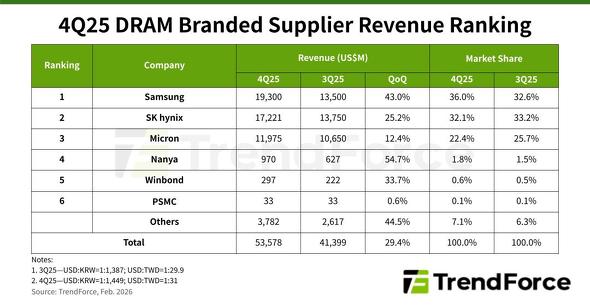
台湾の市場調査会社TrendForceは2026年2月26日(台湾時間)、2025年第4四半期(4Q:10〜12月)の世界DRAM売上高の最新調査結果を発表した。それによると同市場は前四半期比29.4%増の535億7800万米ドルになった。ベンダー別ランキングではSamsung Electronics(以下、Samsung)が同43.0%増の成長を見せ、SK hynixからトップの座を取り戻した。 2025年第4四半期のDRAM市場ランキング[クリックで拡大] 出所:TrendForce TrendForceによると、AIアプリケーションが大規模言語モデル(LLM)の学習から推論へと拡大していることを受け、CSP(クラウドサービスプロバイダー)はデータセンターの建設をAIサーバだけでなく、汎用サーバも含める形で拡大。この動きによって、メモリの調達対象は広帯域メモリ(HBM)のHBM3EやLPDDR5X、高容量RDIMMにとどまらず、さまざまな容量のRDIMMへと広がっているという。さらに積極的な追加発注によって従来型DRAMの契約価格が急上昇。その結果、2025年第4四半期のDRAM市場全体の売上高は前四半期比29.4%増の535億7800万米ドルに拡大した。 TrendForceは「各市場セグメントにおいて需要と供給の差が拡大する中で、買い手は十分な供給を確保するのに苦戦している」と指摘。これによってサプライヤー側の価格決定力が大きく強まり、従来型DRAMの契約価格が前四半期比で45〜50%上昇。従来型DRAMとHBMを合わせた平均契約価格は50〜55%上昇したという。 SK hynixは25.2%増と堅調も、王座奪われる 2025年第4四半期の企業別売上高ランキングを見ると、Samsungが前四半期比43.0%増の193億米ドルとなり、SK hynixから首位の座を奪還した。平均販売価格(ASP)は同約40%上昇していて、上位3社の中で最も高い伸びを見せたという。一方で、ビット出荷量は一桁台前半の伸びにとどまってはいるが、HBM事業の拡大がこれを支え、会社の見通しとも一致する結果での着地となっている。市場シェアも3.4ポイント上昇し36%になった。 SK hynixも前四半期比25.2%増の172億2100米ドルと堅調に拡大しているが、Samsungに抜かれ2位に転落。市場シェアは1.1ポイント低下して32.1%になった。ASPは同20%台半ばの上昇を見せた。これは、契約価格の変動が比較的小さいHBMの売り上げ比率が競合他社より高いためだという。ビット出荷量は一桁台前半の増加で、ガイダンス通りだった。 3位のMicron Technologyは前四半期比12.4%増の119億7500万米ドルに拡大したが、市場シェアは3.3ポイント低下し22.4%となった。ASPは同約17%の上昇を見せたが、上位3社の中では最も低い伸びとなった。また、ビット出荷量は同約4%減となった。これは韓国の競合企業よりも早い段階で契約価格を交渉していた結果、実現した価格水準が相対的に低くなったことが背景とみられるという。 このほか台湾DRAMメーカーも、2025年第2四半期から続く好調な勢いを維持。2025年第4四半期には多くの企業で前四半期比30%を超える売り上げ成長を記録したという。TrendForceは「これらの企業は主に成熟プロセス製品に注力していて、大手メーカーが先端プロセスへ生産を移行する中で生じた供給不足を補う役割を果たしている」とコメントしている。 26年第1四半期、従来型DRAMの価格90〜95%増に TrendForceは2026年第1四半期の市場について、消費者向け需要の季節的な弱さがビット出荷量の伸びを抑制し、サプライヤーの四半期成長が横ばいになる可能性があるとしている。ただし、CSPは供給確保を優先し、より高い調達価格も受け入れる姿勢を示しているため「他の用途分野の顧客も割り当てを維持するためには同様に価格上昇を受け入れる必要がある」とも言及。2026年第1四半期には契約価格の上昇がさらに加速し、従来型DRAMの価格は前四半期比で90〜95%上昇し、従来型DRAMとHBMを合わせた価格も80〜85%上昇すると見込んでいるという。 26年1QにDRAM価格は9割超上昇へ、ソニーらの決算にみる波及の形 関連記事 2026年のメモリ市場は「制御された供給不足」に 主役はHBM4 TechInsightsのアナリストによると、「メモリメーカーは過去の好況と不況のサイクルから学び、AI主導の需要に対応するための増産において、より規律ある姿勢を示している」という。HBM/DRAMの供給不足が予測されているが、これはサプライチェーンの混乱によるものではなく、予想を超えるようなかつてない規模で導入が進んでいることが原因だ。 26年メモリ市場は134%成長 ファウンドリー市場の2倍超に TrendForceによると、AIブームによる需要増および供給制約と価格上昇を背景に、2026年のメモリ市場の市場規模は前年比134%増の5516億米ドルに達し、ファウンドリー市場の2倍以上になる見込みだという。 26年1QにDRAM価格は9割超上昇へ、ソニーらの決算にみる波及の形 メモリ価格の上昇ペースが一段と加速。各社の決算会見では、その影響を示唆する発言が出始めています。 王者SK hynixは16層HBM4「初公開」でアピール、競争過熱のメモリ業界 競争が激化するHBM市場。今回のCESでは、同市場で現在『王者』の座にいるSK hynixが、開発中の16層HBM4の実物および主要スペックを初公開し、そのリードを印象づけました。 2026年のHBM市況、カギを握るのは最新世代「HBM4」 2025年8月に開催された「FMS(the Future of Memory and Storage)」の一般講演を紹介するシリーズ。今回はTrendForceのアナリストであるEllie Wang氏の講演を取り上げる。広帯域メモリ(HBM)の生産能力や容量、価格を予測する。 DRAM市場でSK hynixが首位独走、Samsung引き離す 25年Q2 台湾の市場調査会社TrendForceによると、2025年第2四半期(4〜6月)の世界DRAM売上高は前四半期比17.1%増の316億3000万米ドルになった。ランキングではSK hynixが前四半期に続き首位となり、2位のSamsung Electronics(以下、Samsung)との差を広げた。 関連リンク プレスリリース(英文) Copyright © ITmedia, Inc. All Rights Reserved.

来源:EETimes Japan发布时间:2026-03-05
Siemens Reveals Agentic Questa

Key takeaways ▼ There’s no denying that verification now leads the field in agentic AI announcements, accelerating the trend around this significant contribution to design automation. Siemens have just announced their Questa One Agentic Toolkit, their response to this trend, building on the core Questa One platform. Questa One provides integrated simulation, static verification, embedded AI driving common management around those tools, also VIP in support of these functions. The Agentic Toolkit adds further automated creation and orchestration of verification tasks to provide end-to-end solutions. Boasting endorsements from NVIDIA and MediaTek among others, this update is worth a look. Strategy and foundation Announcements in this space are inevitably similar, so what makes the Siemens approach different? They are leading with a foundation of openness and organic development. Start with openness. The Agentic Toolkit provides MCP interfaces to underlying Questa One functions with the ability to connect to any agentic frameworks. Their own agentic app, Fuse, naturally fully utilizes these interfaces and is the “preferred” option but does not limit other frameworks from connecting. Sidebar on this point: tool providers have a natural advantage in knowing how best to use their own tools. That expertise can be captured in vectorized knowledge embedded in agentic apps. But how well does this work in a mix-and-match flow? More should be debated here between design teams and verification technology providers. The organic differentiation is also interesting. Siemens have built their Fuse EDA AI system in-house. Supported workflows leverage the NVIDIA Llama-Nemotron reasoning framework and NVIDIA NIM inference microservices, enabling the platform to understand verification state in real time and maintain comprehensive awareness and contextual intelligence relationships between designs, testbenches, test plans and specifications. No doubt thanks to these foundation frameworks this system apparently also works with main-stream AI coding applications, including GitHub Copilot, Claude Code, Cursor, and Cline, and can be used in command-line mode (for scripting) or through IDEs such as VS-Code. All this works with a multi-model EDA data lake, capturing baseline manuals and user documentation. An LLM exploits this information in assistants, reasoners, etc., to direct run objectives and orchestration. They also add that building on the existing connected ecosystem between Questa One, Tessent™ software for DFT and the Veloce™ CS hardware-assisted verification and validation system, the Agentic Toolkit supports a broad range of design and verification objectives. This system ships today with several pre-built and tested agents for customers who need a quick start in pilot trials: an RTL code agent, a Lint agent, a CDC agent, a verification planning agent and a debug agent. Expanding a little on the values they describe, the Verification Agent organizes tasks, coverage goals, and requirements, offering AI-driven suggestions for efficient resource allocation, from which engineers gain clarity, adaptability, and accelerated closure, ensuring comprehensive verification and faster project success. The Debug Agent accelerates root-cause analysis by pinpointing issues in RTL and testbenches with AI-driven insights. It offers targeted suggestions, automates error tracing, and guides engineers to efficient resolution. With smart diagnostics, it reduces debug cycles and boosts productivity, helping teams deliver robust designs faster. What about guardrails and trust? This a question I am now asking all agentic verification solution providers. The upside of hands-free automation is huge; the downside of unsupervised AI could be even more dramatic. I asked Abhi Kolpekwar (Sr. VP and GM at Siemens Digital Industries) for his views on this challenging balance. Abhi agreed that while across all industries there is buzz around the potential of AI and agentic methods, there is equally buzz around hype outrunning reality and most pilot programs failing to translate to production. How do successful deployments navigate this challenge? Abhi had a two-part answer. First, while those surveys certainly highlight a problem, we shouldn’t underestimate the success AI/Agentic already enjoys in quietly successful embedded use-cases. Examples include cars (I have written recently about this), in our phones, and in factory automation. Another interesting example is a method to detect what you are saying by watching your facial muscles, even without needing to hear clear speech. Not available yet but presumably coming to a phone, car or other device near you in the not-too-distant future. Intriguing, but in SoC and system we are very sensitive to reliability and pinpoint accuracy. How can AI/Agentic align with these needs? In Abhi’s view, one way to secure that level of quality is through guardrails implemented using proven and non-AI core EDA technologies: formal methods, simulation, and so on. The second way is to implement processes which require human-in-the-loop judgement at checkpoints. There can still be a big win, even though the whole process isn’t pushbutton. With agentic support, DV engineers graduate from being tool operators, knowing all minutiae of how to run (and debug) scripts and tools, to instead becoming verification scientists, knowing how to judge outcomes at intermediate steps, and what high-level correction they might want to try to correct an outcome. I like it – what DV engineer wouldn’t want to upgrade their day-to-day workload to become a verification scientist? Nice positioning. Still, the proof will be in how DV engineers and product managers will react in practice. You can read more about the release HERE and get more insight on product details HERE. Share this post via:

来源:SemiWiki.com发布时间:2026-03-05
共73079条记录
  • 1
  • 2
  • 3
  • 4
  • 6090

产业专题

产业大脑平台

产业经济-监测、分析、

研判、预警

数智招商平台

找方向、找目标、管过程

产业数据库

产业链 200+

产业环节 10000+

产业数据 100亿+

企业数据库

工商 司法 专利

信用 风险 产品

招投标 投融资

报告撰写AI智能体

分钟级生成各类型报告