五度易链产业数字化管理平台
HFW Appoints First Head of Legal Technology Adoption

International law firm HFW has appointed Ashleigh Ovland as its first Head of Legal Technology Adoption, a newly created role reflecting the firm’s increasing use of AI and legal technology to support clients and lawyers across its global network. The firm, which is well-known in areas such as energy, transport, insurance, and construction, said that Ovland will ‘identify where AI and other legal technologies can enhance client outcomes, strengthen relationships, and improve the efficiency and quality of legal delivery’. Her remit includes embedding technology into day‑to‑day practice and ensuring the firm maximises the return on its legal technology investments across its sectors. She will work closely with the firm’s Chief Technology Officer, John Court, and the firm’s AI Committee, they added She was previously an aviation Partner in the firm’s Hong Kong office and led the development of HFW’s ‘Flight Deck’ technology platform for airline industry clients, a client role she will continue actively to support. Giles Kavanagh, Global Senior Partner, and Jeremy Shebson, Managing Partner, HFW, commented: ‘Technology and AI are increasingly important to how we deliver value to clients, but success depends on thoughtful, lawyer‑led adoption, rather than technology for its own sake. This new role underlines our focus on embedding technology into day‑to‑day practice across the firm, supporting our lawyers and ensuring we achieve real returns from our legal technology investments. Ashleigh’s background as a Partner and knowledge leader, together with her deep, hands-on legal technology experience, makes her ideally placed to help us continue on this journey.’ And Ovland added: ‘This is very much a team effort, and I’m looking forward to continuing to work with our lawyers to understand where AI and other legal technology can make a meaningful difference to our offering at HFW, and then making sure that these tools are embedded in a way that delivers real value – to our clients and our people.’ Congrats to Ashleigh. More about HFW here. — A Legal Tech Conference For All of Europe Legal Innovators Europe – Paris – June 24 and 25. There will be more news about the conference and key speakers as we get closer to June. Look forward to seeing you there! Richard Tromans, Founder, Artificial Lawyer and Legal Innovators conference Chair. Note: the conferences are organised by Cosmonauts – please contact them with any queries. If you would like to be a speaker at Legal Innovators Europe, especially if you are at a law firm or inhouse legal team in Europe – whether based in France, Belgium, Spain or Germany, or beyond…..then please contact Phoebe at Cosmonauts: phoebe@cosmonauts.biz Note: if you are a legal tech company, please contact Robins: robins@cosmonauts.biz or Anjana anjana@cosmonauts.biz – And if you’re in the US and looking for the next major event to join after Legal Week, then see you in California this June! Legal Innovators California, the landmark West Coast legal tech event, will take place on June 10 and 11, in the heart of the Bay Area, the home to many of the world’s leading AI businesses – and plenty of legal tech pioneers as well! More information and tickets here. Share this:Tweet Click to email a link to a friend (Opens in new window) Email Discover more from Artificial Lawyer Subscribe to get the latest posts sent to your email. Type your email… Subscribe


来源:Artificial Lawyer发布时间:2026-03-05
Ivo 6x’s Revenue, Opens in London + NY

Ivo, the San Francisco-based contract intelligence platform for inhouse teams, is opening new offices in London and New York, as it also reports 6x-ing its revenue…. in 12 months…! The company, which first started in New Zealand, noted that the growth follows a very recent $55m funding round. They also plan to triple headcount to 180 employees, and have bagged customers such as Uber and IBM along the way already. So, all in all a very good period of growth for Ivo. Congrats to them. Min-Kyu Jung, CEO and co-founder of Ivo (pictured with co-founder Jacob Duligall), commented: ‘It’s been an incredible past 12 months at Ivo, all testament to the robust team and platform we’ve built to serve in-house legal team. We are committed to being where customers are and building a team that will help them succeed.’ And if you’re wondering what Ivo does, it ‘is purpose-built for inhouse contracting teams that need both accurate, precise contract review and real-time visibility across their entire agreement portfolio. It enables teams to review contracts 75% faster and surfaces answers to business-critical questions in minutes rather than months’. Last word goes to Kate Gardner, Senior Manager, Contract Operations at Uber, who said: ‘Uber selected Ivo because it was intuitive to use, demonstrated a high level of accuracy, could work in multiple languages, and met its confidentiality requirements. Furthermore, the Ivo team was highly responsive to Uber’s needs.’ Welcome to London! And see you in New York as well! More about Ivo here. — A Legal Tech Conference For All of Europe Legal Innovators Europe – Paris – June 24 and 25. There will be more news about the conference and key speakers as we get closer to June. Look forward to seeing you there! Richard Tromans, Founder, Artificial Lawyer and Legal Innovators conference Chair. Note: the conferences are organised by Cosmonauts – please contact them with any queries. If you would like to be a speaker at Legal Innovators Europe, especially if you are at a law firm or inhouse legal team in Europe – whether based in France, Belgium, Spain or Germany, or beyond…..then please contact Phoebe at Cosmonauts: phoebe@cosmonauts.biz Note: if you are a legal tech company, please contact Robins: robins@cosmonauts.biz or Anjana anjana@cosmonauts.biz – And if you’re in the US and looking for the next major event to join after Legal Week, then see you in California this June! Legal Innovators California, the landmark West Coast legal tech event, will take place on June 10 and 11, in the heart of the Bay Area, the home to many of the world’s leading AI businesses – and plenty of legal tech pioneers as well! More information and tickets here. Share this:Tweet Click to email a link to a friend (Opens in new window) Email Discover more from Artificial Lawyer Subscribe to get the latest posts sent to your email. Type your email… Subscribe

来源:Artificial Lawyer发布时间:2026-03-05
Prompts Are a Crutch, Legal AI Needs Memory

By Alex Zilberman, CEO, Chamelio.Legal AI is having its ‘prompt library’ moment. Teams are building internal prompt packs, vendors are shipping prompt templates, and everyone is quietly hoping that better phrasing will equal better outcomes. It won’t. Prompt libraries rot and don’t scale. Memory turns every negotiation into a compounding advantage by learning what gets accepted, rejected, escalated, and ultimately signed, and then producing more consistent outputs over time. And it’s not just negotiations. Memory becomes truly powerful when it’s gathered from all your legal AI interactions, across: Word based negotiations (what you apply, rewrite, ignore, and why) Web agent legal research (what sources you trust, what you cite, what you discard) Questions asked and answered (what your team asks repeatedly, and what ‘good’ answers look like internally) Querying your contract repository and legal knowledge base (how you search, what you pull, what ends up being used) That difference, one off instructions versus compounding learning, is where the next real wave of legal AI will be won. Prompting doesn’t compound. It decays. Prompting is a human workaround for a system that doesn’t know your reality. It usually starts strong. A few power users build prompts that genuinely help. Then the organization grows, standards evolve, fallback language changes, business priorities shift, and new issues show up. Suddenly the ‘great prompts’ are: Incomplete (they don’t reflect the latest internal standards) Inconsistent (different lawyers edit them differently) Brittle (small changes produce big output swings) Invisible (no one can tell which version is the one) So the prompt library becomes what every shared doc becomes, a graveyard of half truths. In legal work, the failure isn’t that the AI can’t write. It’s that the AI can’t reliably write to your standards, under your constraints, and keep doing that as those standards shift. That can’t be solved with more prompt engineering. It can only be solved with memory. Legal work is repeatable judgment under constraints Legal work isn’t creative writing. It’s repeated decisions: ‘Do we accept this limitation or carveout?’ ‘When do we escalate this issue, and to whom?’ ‘What’s our fallback position in this scenario?’ ‘How do we explain this risk to the business in a way they’ll actually understand?’ Those decisions aren’t random. They depend on internal policy, risk appetite, context, the matter at hand, and the team’s communication style. And the most valuable part, the part that makes a legal team feel like a legal team, is the consistency of those decisions. That’s why the best legal AI doesn’t just need to be smart. It needs to know what ‘smart’ means for your team, and remember it. That consistency comes from institutional memory. Not prompts. What ‘memory’ means in legal AI (and what it doesn’t) When I say ‘memory,’ I’m not talking about a model that hallucinates a personality. I’m talking about a product layer that captures and reuses what legal teams already do, across the tools they already use. Memory can be as simple as: Which redlines were applied versus discarded (in Word) Which sources were used versus ignored (in research) Which questions get asked repeatedly, and which answers get accepted (in Q and A) Which documents are retrieved from the repository and actually used (in your knowledge base and contract repository) Which issues triggered escalation, and what resolved them What ended up final (signed, filed, approved, or relied upon) Which policies and playbooks were applied in which contexts, and when they were overridden How we explain positions to counterparties (tone, detail level, and what framing gets traction) Who handled which types of requests, and which routing decisions worked This can be stored as structured signals tied to topic, clause type, matter type, jurisdiction, counterparty profile, business unit, and role. It is not ‘training your own model in a black box.’ The governance question: what if it learns the wrong thing? Every GC will ask: ‘If it learns from our actions, can it learn the wrong behavior?’ Yes, unless you build memory like an enterprise system, not a consumer personalization feature. Practical guardrails make this safe: Versioning. Memory tied to a specific policy version, with rollback Scope. Memory applied by matter type, jurisdiction, business unit, and role Confidence thresholds. ‘Suggest’ versus ‘auto apply’ based on evidence volume and risk Human overrides. A single explicit ‘this is the new standard’ action updates the system faster than passive observation Auditability. Show why a suggestion was made, for example ‘based on X accepted outcomes in similar situations’ These controls aren’t optional. They’re what makes memory deployable. The new KPIs for legal AI If your goal is faster, safer legal work, ‘AI usage’ is not the KPI. The KPIs that matter are operational: Variance reduction. fewer different outcomes for the same issue across the team Escalation rate. fewer unnecessary escalations without increasing exceptions Time to answer. how quickly you get to an internally acceptable response (especially in research and Q and A) Time to first clean output. how close the first draft or answer is to acceptable Rework volume. how often lawyers redo the same changes Adoption beyond power users. whether average users get reliably good results Memory should move these numbers. If it doesn’t, it’s not memory, it’s just autocomplete. A simple maturity model: from prompts to memory Level 1: Prompted assistanceGood first drafts and answers. Inconsistent. Heavily user dependent. Level 2: Policy aware assistancePlaybooks, guidance, and source lists embedded, still largely static. Level 3: Memory driven consistencyLearns from accepted and rejected edits, trusted sources, and outcomes. Reduces variance. Level 4: Memory driven executionMemory triggers routing, approvals, follow ups, and governance actions. AI changes behavior across workflows. Most of the market is stuck between Level 1 and Level 2.The winners will climb to Level 3 and 4. The point The next era of legal AI isn’t about making models sound more lawyerly. It’s about building systems that behave like experienced legal teams, consistent, contextual, and continuously improving. Prompts don’t compound. Memory does. In a world where everyone has access to the same frontier models, the compounding layer, the memory layer, becomes the only real competitive advantage in day to day legal work. How We’re Building This at Chamelio This isn’t theoretical. At Chamelio, we’re building legal memory as a product layer across every AI interaction lawyers have. – [ This is a sponsored thought leadership article by Chamelio for Artificial Lawyer. ] Share this:Tweet Click to email a link to a friend (Opens in new window) Email Discover more from Artificial Lawyer Subscribe to get the latest posts sent to your email. Type your email… Subscribe
来源:Artificial Lawyer发布时间:2026-03-05
Product Walk Through: Harvey – Shared Spaces

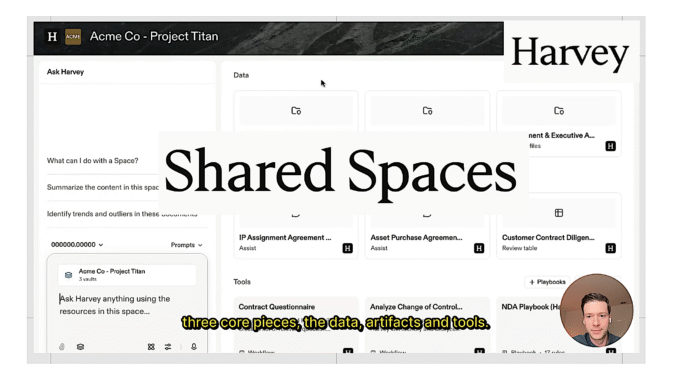
Today’s AL TV Product Walk Through is all about Harvey’s Shared Spaces, a new product designed to redefine how law firms and clients collaborate on legal work. Please press Play to watch the video, or you can also go direct to the AL TV Channel to watch over 220 other videos for free. AL TV Productions, 2026. And here’s how Harvey describes things: ‘A Shared Space is a secure, branded environment within Harvey where firms and clients can organize and co-create work in one unified, searchable place. Instead of relying on client portals or file-sharing tools, both sides contribute to shared resources in real time, collaborating across internal teams and with external partners. Robust governance controls — including object-level permissions, ethical walls, audit trails, and administrative controls — ensure sensitive work remains protected at every stage. ‘For law firms, Shared Spaces enable differentiated service delivery and deeper client relationships by turning expertise into reusable, compounding value. For in-house teams, they provide real transparency into how outside counsel is working and how knowledge is being built over time. Customers worldwide are already collaborating on Harvey with Shared Spaces.’ If you would like to know more about Shared Spaces then please see here. — Share this:Tweet Click to email a link to a friend (Opens in new window) Email Discover more from Artificial Lawyer Subscribe to get the latest posts sent to your email. Type your email… Subscribe
来源:Artificial Lawyer发布时间:2026-03-05
"WTO members consider new e-commerce proposal and previous submissions ahead of MC14"

Switzerland, on behalf of co-sponsors, presented the proposal for the Ministerial Conference to mandate the establishment of a Committee on Digital Trade that would build on the work done under the Work Programme and provide a stable forum for digital trade discussions at the WTO. This would be in addition to an extension of the moratorium on the imposition of customs duties on electronic transmissions. Members provided their initial comments on the proposal and also expressed views on two previous submissions: one by the African, Caribbean and Pacific (ACP) Group proposing the reinvigoration of the Work Programme with a focus on the development dimension and the extension of the moratorium until the following ministerial conference; and one by the United States and co-sponsors for a permanent moratorium. The facilitator of the Work Programme on Electronic Commerce, Ambassador Richard Brown of Jamaica, welcomed members' active participation and called on proponents to try to find landing zones. "While there are some areas of convergence, some critical substantive differences remain. In this regard, I would like to ask the proponents to engage with each other, to try and identify any common elements, areas of flexibility and the possible way forward," he said. He said discussions will continue ahead of the General Council meeting on 10-11 March to try to identify common elements for a draft ministerial decision. The facilitator also noted that the early version of a database compiling technical assistance and capacity building on e-commerce is now available for members to review and provide feedback on.

来源:世界贸易组织发布时间:
"EU contributes EUR 1 million to strengthen trade capacity in developing economies, LDCs"

This contribution to the WTO's Global Trust Fund (GTF) will help finance the implementation of the WTO's technical assistance plan through targeted capacity-building initiatives. These programmes enable government officials from developing economies including LDCs to deepen their understanding of the multilateral trading system and enhance the implementation of their WTO obligations. WTO Director-General Ngozi Okonjo-Iweala welcomed the EU's contribution: "The European Union's EUR 1 million contribution to the Global Trust Fund comes at a critical time and will help maintain valuable technical assistance activities for developing economies and least developed countries. I welcome the EU's leadership and hope it will encourage other members to step forward in support of the WTO's capacity building work." H.E. Mr João Aguiar Machado, Ambassador and Permanent Representative of the European Union to the WTO, highlighted the importance of continued EU support for WTO technical assistance programmes: "The European Union is pleased to contribute EUR 1 million to the WTO's Global Trust Fund. At a time when sustained and predictable financing for technical assistance is particularly important, this contribution reflects the European Union's longstanding support for the Global Trust Fund and for the WTO's technical assistance programmes. Strengthening the capacity of developing economies including least developed countries is essential for a fair and effective multilateral trading system." The Global Trust Fund finances approximately 280 activities each year, primarily through tailored training delivered at the national and regional levels, including online. These activities span a wide range of trade-related areas, including agriculture, digital trade, import licensing, standards, trade and environment, and trade negotiation skills. Since its establishment in 2001, the Global Trust Fund has supported over 2,800 training workshops worldwide. The year 2024 saw the highest number of technical assistance activities in the last decade, with over 19,000 participants trained throughout the year. Building on more than two decades of constructive cooperation with the WTO, the European Union has contributed a total of CHF 34.5 million to various WTO trust funds. This latest contribution recognizes and reinforces the European Union's commitment to promoting a fair, inclusive and rules-based multilateral trading system.

来源:世界贸易组织发布时间:
E-Lastenräder: Miet­programm „Stuttgarter Rössle“ wird neu ausgerichtet

Die Landeshauptstadt Stuttgart entwickelt ihr E‐Lastenrad‐Vermietprogramm „Stuttgarter Rössle“ weiter und richtet es künftig gezielt an Familien mit begrenzten finanziellen Möglichkeiten aus. Gleichzeitig wurde das Förderprogramm E‐Lastenräder für Stuttgarter Familien zum Jahresende 2025 beendet. Ein Abschlussbericht bescheinigt dem Programm eine hohe verkehrliche und ökologische Wirkung.

来源:STUTTGART发布时间:2026-03-05
Stuttgart und Nanjing bekräftigen engere Kooperation in Wirtschaftsthemen

Die Landeshauptstadt Stuttgart und die Hauptstadt der chinesischen Provinz Jiangsu, Nanjing, haben eine gemeinsame Absichtserklärung zur weiteren Vertiefung ihrer über 30-jährigen Partnerschaft unterzeichnet. Die Vereinbarung wurde im Stuttgarter Rathaus von Oberbürgermeister Frank Nopper und seinem Amtskollegen Li Zhongjun unterzeichnet. Ziel ist es, die Zusammenarbeit der beiden Städte insbesondere in wirtschaftlichen und technologischen Zukunftsfeldern auszubauen und die 30-jährige Partnerschaft beider Städte damit in eine neue Ära zu führen.Vor der Unterzeichnung hatten Vertreter beider Städte bereits wirtschaftliche Themen im neuen Haus des Tourismus diskutiert. Dabei konkretisierte Oberbürgermeister Nopper, wozu man einander im Bereich der Wirtschaft brauche: „Als Kooperati­onspartner, als Abnehmer, als Investoren – zum wechselseitigen Nutzen sowie zu fai­ren Bedingungen und Spielregeln.“

来源:STUTTGART发布时间:2026-03-05
Dienst für das Kulturdenkmal: Ehrenamtliche betreuen das Alte Rathaus

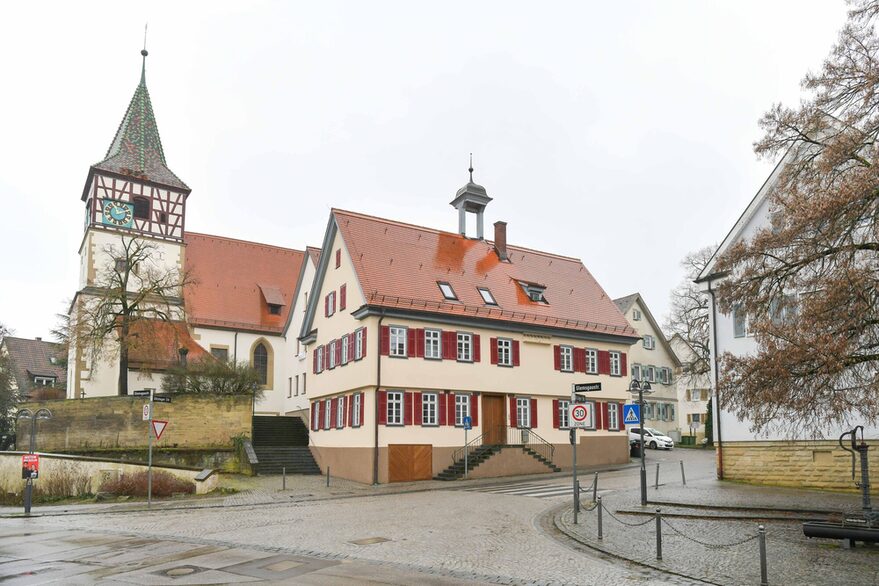
Es ist viel Herzblut im Spiel, wenn es um das Alte Rathaus von Weilimdorf geht. Das 421 Jahre alte Gebäude unterhalb der Oswaldkirche „ist unser Schmuckstück“, sagt Julian Schahl, der Vorsteher des 32.000 Einwohner zählenden Stadtbezirks. Mehr als 150 Veranstaltungen hat dieses Schmuckstück im vergangenen Jahr eine Bühne gegeben. Für viele Verliebte hat das Alte Rathaus einen besonderen Platz in ihrem Herzen: Allein 2025 haben dort 30 Paare Ja zueinander gesagt.Dass das Schmuckstück in der Ortsmitte auch 2026 ein Ort des Miteinanders, der Kultur und ein Wunschtrauort sein kann, das ist dem engagierten Team des Heimatkreises zu verdanken. Denn die Vorsitzende Edeltraud John und Walter Niklos haben sich zusammen mit Bärbel Breuel, Loni Huss, Bernd Klingler und Jannette Wöhrle bereit erklärt, vorerst die Hausmeistertätigkeiten im Alten Rathaus zu übernehmen – im Ehrenamt. /service/aktuelle‐meldungen/2026/maerz/dienst‐fuer‐das‐kulturdenkmal‐ehrenamtliche‐betreuen‐das‐alte‐rathaus.php.media/445991/weilimdorf‐gesamt‐kovalenko.jpg.scaled/f217086c5c8cca2698e9fddd986f6318.jpgHistorisches Ensemble: das Alte Rathaus von 1605 unterhalb der Oswaldkirche.

来源:STUTTGART发布时间:2026-03-05
Waffen- und Messerverbotszone in Stuttgart zeigt Wirkung

Stuttgarts Oberbürgermeister Dr. Frank Nopper, der für die Ausweisung der Waffen‐ und Messerverbotszone zuständig ist, und Polizeipräsident Markus Eisenbraun zeigen sich sehr zufrieden über den deutlichen Rückgang schwerer Straftaten mit dem Tatmittel Messer im Geltungsbereich der Waffen‐ und Messerverbotszone im Kernbereich der Stuttgarter Innenstadt. Die Straftaten gegen Leib und Leben sowie die Rohheitsdelikte sind von 91 Fällen im Jahr 2024 auf 46 Fälle im Jahr 2025 zurückgegangen und haben sich damit nahezu halbiert. „Die Ausweisung der Waffen‐ und Messerverbotszone hat Sicherheit und Sicherheitsgefühl im Kern unserer Innenstadt stark erhöht. Die Zahlen zeigen eindrucksvoll, dass wir auf dem richtigen Weg sind.“Oberbürgermeister Dr. Frank NopperNopper weiter: „Wir sollten unseren klaren Kurs fortsetzen und die starke Polizeipräsenz auch im laufenden Jahr aufrechterhalten.“

来源:STUTTGART发布时间:2026-03-05
Einwohnerversammlung in Stuttgart-Nord: Jetzt Themen online mitbestimmen

Das Online‐Verfahren ist auf dem städtischen Beteiligungsportal Stuttgart – meine Stadt (Öffnet in einem neuen Tab) zu erreichen und gliedert sich in zwei Phasen: 9. bis 23. März: Interessierte können aus einer Liste die Themen ankreuzen, die ihnen für ihren Stadtbezirk am wichtigsten sind. 24. März bis 13. April: In dieser Zeit können konkrete Anliegen und Fragen online eingereicht werden. Zudem besteht die Möglichkeit, die Beiträge anderer Teilnehmer zu bewerten. Fragen, die über das Portal eingereicht werden, beantwortet die Fachverwaltung direkt online auf der Plattform. Sie werden am Abend der Versammlung nicht automatisch erneut aufgerufen.Wer am 27. April persönlich eine Frage an die Stadtspitze richten möchte, kann dies direkt vor Ort tun. Hierzu liegen im Eingangsbereich der Sparkassenakademie Karten aus. Einwohnerinnen und Einwohner des Stadtbezirks Stuttgart‐Nord können dort ihr Anliegen notieren und sich für einen Wortbeitrag anmelden. Oberbürgermeister Dr. Frank Nopper wird die Teilnehmenden im Laufe des Abends einzeln aufrufen.

来源:STUTTGART发布时间:2026-03-05
Stadt fördert Kunst- und Kulturprojekte mit neuem Förderfonds „Kulturelle Teilhabe“

Künstlerinnen und Künstler, Vereine, Organisationen, Initiativen sowie soziale Träger wie Mehrgenerationenhäuser, Jugendhilfen oder Verbände können jetzt finanzielle Unterstützung über den neuen Förderfonds „Kulturelle Teilhabe“ erhalten.Bis zum 15. Mai können Anträge für eine Einzelprojektförderung sowie für die Unterstützung neuer Partnerschaften zwischen Kunstschaffenden und Zivilgesellschaft im Rahmen der „Förderung von Partnerschaften und Kooperationen für gesellschaftlichen Zusammenhalt“ eingereicht werden.Kleine, unterjährige Projekte können auch außerhalb dieser Frist gefördert werden. Insgesamt gibt es drei Möglichkeiten, Fördergelder aus diesem Fonds zu bekommen. Der Gemeinderat der Landeshauptstadt Stuttgart hat insgesamt 100.000 Euro für den neuen Fördertopf bewilligt.

来源:STUTTGART发布时间:2026-03-05
共73103条记录
  • 1
  • 2
  • 3
  • 4
  • 6092

产业专题

产业大脑平台

产业经济-监测、分析、

研判、预警

数智招商平台

找方向、找目标、管过程

产业数据库

产业链 200+

产业环节 10000+

产业数据 100亿+

企业数据库

工商 司法 专利

信用 风险 产品

招投标 投融资

报告撰写AI智能体

分钟级生成各类型报告