
GigaDevice’s $825 million DRAM bet signals a scale breakthrough

专属客服号

微信订阅号
大数据治理
全面提升数据价值
赋能业务提质增效
This isn’t just a supply deal. It marks a turning point in GigaDevice’s ambition to become a major DRAM force, with implications for legacy players worldwide, comments Yole Group’s analysts.
GigaDevice’s planned DRAM purchases from CXMT mark a clear inflection point in its strategy: the company is no longer just passively participating in the DRAM market. Indeed, it is preparing to scale aggressively and capitalize on the current pricing upcycle.
This snapshot was prepared by Daniel Niu and Simone Bertolazzi, analysts within Yole Group’s Memory team. Leveraging Yole Group’s comprehensive collection of memory reports and ongoing market monitors, they provide timely insights into key strategic moves shaping the DRAM landscape and competitive dynamics.
- DRAM purchases from CXMT were roughly $90 million in 2024 and H1-2025 combined,
- The new 2026 agreement alone is approximately 9× larger,
- GigaDevice’s DRAM revenue is estimated at over $200 million in 2025.
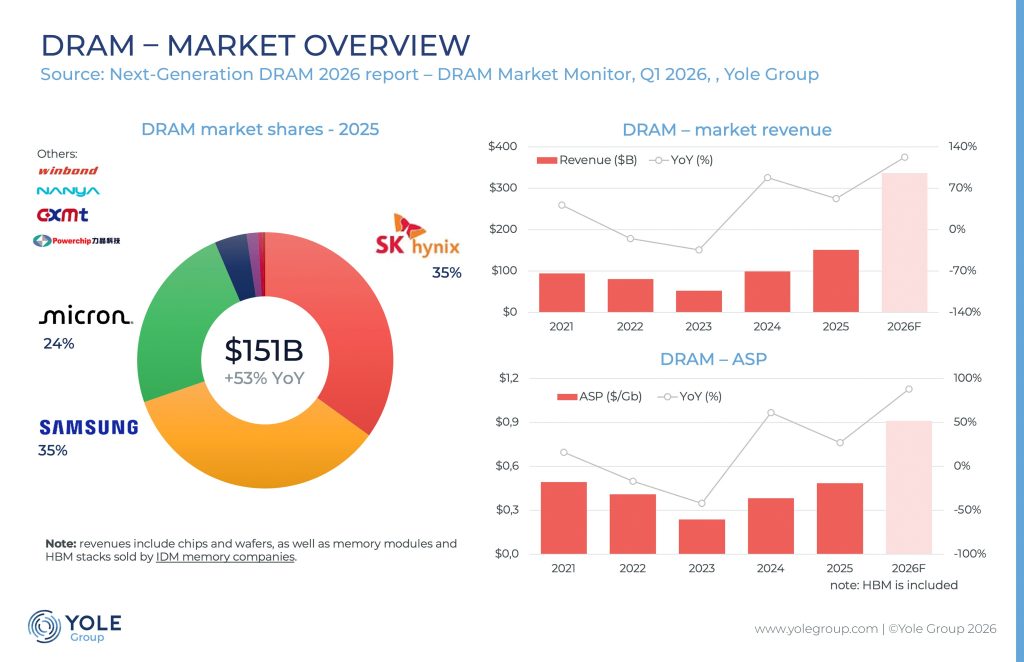
With this step-up in supply, combined with a favorable pricing environment, DRAM revenues could approach $1 billion in 2026, assuming a sizable portion of the purchased DRAM is converted into sales within the year.
But beyond the numbers, the structure of this partnership matters.
GigaDevice and CXMT are deeply intertwined:
- Same chairman, Zhu Yiming,
- GigaDevice holds about 1.8% stake in CXMT’s parent company,
- A tightly coupled design–manufacturing model.
GigaDevice is often described as the “overseas arm” of CXMT. In reality, it is becoming something more strategic. As a leading NOR Flash and MCU supplier with strong penetration in consumer and industrial markets, GigaDevice is uniquely positioned to:
- Develop and market DRAM products, including DDR3, DDR4 and LPDDR4, based on CXMT’s DRAM,
- Reach customers beyond China,
- Address growing shortages in legacy DRAM, as many companies struggle to source from global suppliers.
Looking ahead, this move could increase competitive pressure on legacy and specialty DRAM players, including Winbond, Nanya, PSCM, and fabless suppliers such as ISSI.
If executed well, this model could reshape parts of the legacy DRAM market.
GigaDevice’s move is more than a volume play. It signals a shift in how scale, partnerships, and market access can redefine competition in DRAM. The coming months will be critical to see whether this strategy translates into lasting market impact.
To go further, feel free to reach out to Yole Group’s analysts with questions and explore more insights through Yole Group’s memory reports and market monitors on our website.
Stay tuned!
About the authors

Daniel Niu is a Market Researcher in Computing, Software, and Memory at Yole Group.
Daniel supports and conducts the development of Yole Group’s analyses, providing accurate, high-quality technical information and market data. He monitors the computing and memory industry daily to identify key information on market evolution, company announcements, investments, and moves across the supply chain with a strong focus on Greater China.
Daniel has core expertise in NAND, DRAM, ENVM memory, processors, microcontrollers, AI, and neural networks.
Prior to Yole Group, Daniel had 4 years of market research experience. He also monitored national economic activity in China to gain a detailed overview of China’s macroeconomic and microeconomic development.
Daniel obtained a master’s degree in chemical engineering from East China University of Science and Technology (China).

Simone Bertolazzi, PhD, is Principal Analyst, Memory at Yole Group.
As a member of the Yole Group’s Memory team, Simone contributes regularly to the analysis of markets and technologies, their related materials, device architectures, and fabrication processes.
Previously, Simone conducted experimental research in the field of nanoscience and nanotechnology, focusing on emerging semiconducting materials and their opto-electronic device applications. He (co-)authored more than 20 papers in scientific journals and was awarded the prestigious Marie Curie Intra-European Fellowship. Simone obtained a PhD in physics in 2015 from École Polytechnique Fédérale de Lausanne (Switzerland), where he developed novel flash memory cells based on heterostructures of two-dimensional materials and high-κ dielectrics. Simone earned a double M.A.Sc. degree from Polytechnique de Montréal (Canada) and Politecnico di Milano (Italy), graduating cum laude
- Next-Gen DRAM 2026 – Focus on HBM and 3D DRAM
- Emerging Non-Volatile Memory Comparison 2026
- Status of the Memory Industry 2025
- CXMT G4 DDR5 DRAM